
Britain's first female prime minister whose three
terms broke the pattern of postwar politics
Anne Perkins
The
Guardian, Monday 8 April 2013
 |
Margaret Thatcher
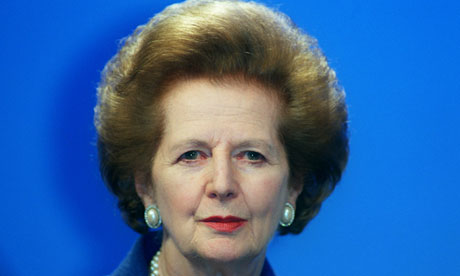
Margaret Thatcher was a global figure, dubbed the Iron
Lady, but her time in power was often mired in controversy. Photograph: Graham
Whitby-Boot/Allstar/Sportsphoto
|
"She came to ignore criticism with a ruthlessness that was in the end her undoing."
Margaret Thatcher, who has died aged 87, was a
political phenomenon. She was the first woman elected to lead a major western
power; the longest serving British prime minister for 150 years; the most
dominant and the most divisive force in British politics in the second half of
the 20th century. She was also a global figure, a star in the US, a heroine in
the former Soviet republics of central Europe, a point of reference for
politicians in France, Germany, Italy and Spain.
In Britain, the Thatcher years were a watershed. After
them, the ideals of collective effort, full employment and a managed economy –
all tarnished by the recurring crises of the 1970s – were discredited in the
popular imagination. They were replaced with the politics of me and mine, deregulation
of the markets and privatisation of the state's assets that echoed growing
individual prosperity. Thatcher did not cause these changes, but she
legitimised and embedded them. Her belief in the moral authority of the
individual and the imperative of freedom of choice led left as well as right to
reappraise the welfare state. Her perception of economics, society and
Britain's place in the world continue to shape British politics.
It is often claimed that she gave no warning of the
revolution she was about to unleash when she won her first majority in 1979. In
fact, although the official manifesto was opaque, her speeches in the years
between defeating Edward Heath for the leadership of the Conservative party in
1975 and coming to power laid out the ideology that underpinned her policies
over the next 11 years.
Thatcher was pragmatic about her methods but constant
in her targets: socialism, the Labour party and above all the collectivist
state that Labour, abetted by one-nation postwar Conservatism, had constructed.
She believed that the state was a burden on private enterprise. Its cost was
crippling the economy and overloading it with debt. Vested interest had been
allowed to flourish, most notably in the trade unions but also in the
nationalised industries of coal, steel and telecommunications.
Many others shared her analysis. The strength of her
beliefs gave her the courage to push on where others might have conciliated.
She came to ignore criticism with a ruthlessness that was in the end her undoing.
She was not the only person who saw a world divided
between good and evil. What marked her out was a willingness to say so, abroad
as well as at home. Soviet leaders, after years of detente, were startled to
find their regime denounced as the embodiment of inhumanity, bent on military
expansion. Before she had won a general election vote in the UK, Thatcher had
won the sobriquet overseas of the Iron Lady.
Only an outsider could have given birth to an ideology
as iconoclastic as Thatcherism, and Thatcher always regarded herself as a
challenger of the status quo, a rebel leader against established power. What
mattered to her was less the breadth of her support than the depth of her
convictions.
In time, there grew around her a mythology that rooted
her absolute faith in the individual in her upbringing above the grocer's shop
in the Lincolnshire town of Grantham. She was the second of two daughters of
Alderman Alfred Roberts and his wife, Beatrice. The two girls were educated at
Kesteven and Grantham girls' school, and at 17 Margaret won a place to study
chemistry at Somerville College, Oxford, where she was tutored by the future
Nobel prizewinner Dorothy Hodgkin (with whom she remained on respectful terms,
despite Hodgkin's passionate opposition to nuclear weapons). She graduated in
1947.
Less than two years later she was selected to contest
the hopeless Kent seat of Dartford, despite the reservations of some party
activists who were appalled at the prospect of a 23-year-old woman as their
candidate. She contested Dartford in both the 1950 and 1951 general elections.
It was at a social function after her first adoption
meeting that she met Denis Thatcher, a businessman with a passion for rugby who
had earlier rejected the chance of fighting the seat himself. Denis drove the
candidate back to London. Well-off, divorced and amiable, Denis ran his family
paint firm, which was later absorbed into Burmah Oil. They were married in
December 1951. In 1953, their twins, Mark and Carol, were born. Denis, it was claimed,
spent the day at a cricket match – Carol later called their marriage "a
partnership of parallel lives" – and while still in the maternity
hospital, Margaret signed up to study for her bar finals. She was called to the
bar at Lincoln's Inn in 1954.
For a young woman with a new family, to become an MP
was unprecedented. But in 1958, she was selected for the rock-solid north
London constituency of Finchley, the seat she represented from October 1959
until she retired at the general election in 1992.
In October 1961, after only 20 months on the
backbenches, the then prime minister, Harold Macmillan, made Thatcher a junior
pensions minister (a job she later gave to her own successor, John Major). It
would be nearly 30 years before she returned to the backbenches. In 1967, with
her party in opposition, she was promoted to the shadow cabinet by the new
party leader, Heath, and when he won the election of June 1970, she became
education secretary, the only woman in the cabinet.
Here, her public reputation was made as "Thatcher
the milk-snatcher", the minister who cut spending by ending universal free
milk for primary school children. It was a defining moment, but also a rare
breach of the Conservatives' unwillingness to disturb the postwar consensus.
Much more in keeping was her continuation of Labour's plan to replace grammar
schools with comprehensives.
But she was at the ringside as Heath's experiments in
monetarism and industrial relations legislation crashed and burned. Heath
resumed the interventionist policies of the 1950s. In February 1974, as a
miners' overtime ban prompted power cuts and the introduction of a three-day
working week, Heath asked: "Who governs Britain?" He lost the general
election. Thatcher later claimed she had always been uncomfortable with Heath's
consensual approach. At the time, however, she was silent and loyal.
However, after Harold Wilson narrowly won a second
election victory in October 1974, Thatcher was among the embryonic new right
preparing to challenge Heath. Its intellectual leader was Keith Joseph, but his
chance of leading the party vanished with a notorious speech, claiming that the
poor had too many children. Thatcher decided she would put her name forward for
the contest. "Someone who represents our viewpoint has to stand," she
told Joseph. Denis told her she was out of her mind, a view echoed in every
newspaper. To a party that could not decide whether it was worse to be female
or to be suburban, she appeared entirely unelectable.
Yet she defeated Heath in the first ballot and four
other contenders in the second. The beaten favourites included William
Whitelaw, the man who was later her indispensable deputy. She won in an ambush
that capitalised on discontent with Heath rather than positive enthusiasm for
her. As a result, she was never sure of her party: "Is he one of us?"
became the defining question of the next 11 years. Many of her backbench
colleagues shared the prevailing view in the Labour government that Thatcher's
leadership made the Tories unelectable. She worked assiduously to meet a
barrage of criticism – criticisms that often focused as much on attributes of
gender as on matters of policy. Her hair, her clothes and particularly her
voice were attacked. Politics remained a largely male preserve, about the
strength to confront, whether it was trade union power, economic crisis or
Soviet threat.
Thatcher's only cabinet-level experience had been in a
relative backwater. She had always conformed to the norms of a woman in public
life. Engaged in discourse largely with men, she observed the conventions,
flirted, sometimes shouted and occasionally wept. Her advisers emphasised the
feminine, softened her appearance and lowered her voice. Yet she was always
most authentic when she was defiant. If a single phrase captured her political
identity, it was from her 1980 party conference speech: "This lady's not
for turning." She played by the rules that demanded that she present
herself as soft and yielding, but by her diligent attention to detail, the
concentration of her focus, and her appetite for conflict, ultimately she
subverted them.
Thatcher drew up a new settlement with the welfare
state, and organised labour and the City in a way that rewarded enterprise and
individual effort over the collective and the communitarian. She regarded group
interests, from trade unions to the professions, as protectors of privilege.
Although monetarism had already been forced upon the
preceding Labour government by the International Monetary Fund, under Thatcher
it was presented as a crusade, until it was discreetly abandoned in the
mid-1980s.As the global slump reached its nadir in early 1981, she and her
chancellor, Geoffrey Howe, defied all appeals for Keynesian-style reflation. In
the first budget of the administration, VAT was nearly doubled to 15% while
personal taxes were slashed – the top rate of income tax from 83% to 60%, and
the standard rate from 33% to 30%. Over the next 10 years, the standard rate
came down to 25%, and the top rate to 40%. Interest rates were to be the
principal method of controlling the money supply. Removing exchange controls
was the first symbolic piece of deregulation. In September 1982, unemployment –
which became the de facto weapon against the trade unions – reached 3 million.
A series of employment acts were introduced which
ended trade unions' traditional show-of-hands votes and brought in secret
pre-strike ballots as well as decennial votes on the political levy. Wages
councils were constrained. In a second tranche of legislation in the late
1980s, the closed shop and secondary strike action were outlawed.
Thatcher thought the government had no role to play in
public sector pay negotiations or in seeking to secure industrial peace. The
steelworkers were the first to clash, and although, in 1981, planned pit
closures were aborted to avert a miners' strike, by early 1984 the government
was prepared – literally – for what was to be the last stand of the old trade
union movement in its heavy industry heartland: the year-long showdown with the
miners that culminated in mass closures and ultimately privatisation.
Thatcher shrugged off record personal unpopularity and
relished facing down her critics. But she would not have survived without the
crisis on the left which led to the formation of the breakaway Social
Democratic party. In 1981 there were riots in Brixton, south London, Toxteth in
Liverpool and Manchester's Moss Side. From March 1984, striking miners and
police were in frequent, violent confrontation. In 1985 Brixton erupted again,
and there was rioting too in the Handsworth area of Birmingham. In the same
year PC Keith Blakelock was murdered during disturbances on the Broadwater Farm
estate in Tottenham, north London.
Privatisation, which came to be a fundamental of the
Thatcherite mission, was only hinted at in 1979, and in the depression of the
early 1980s caution prevailed. When the ailing nationalised motor manufacturer
British Leyland ran into trouble in early 1980, Joseph, then Thatcher's
industry minister, bailed it out like a Heathite. Nonetheless, in 1980-81 more
than £400m was raised from selling shares in companies such as Ferranti and
Cable and Wireless. Later came North Sea oil (Britoil) and British Ports, and
from late 1984 the major sales of British Telecom, British Gas and British
Airways, culminating at the end of the decade in water and electricity. By this
time these sales were raising more than £5bn a year.
Conflict was at the heart of Thatcher's style. But it
is a myth that she never ducked a challenge. Ever a pragmatist, she was astute
in the fights she picked. The battles during her first term, from 1979 to 1983,
ranged across a forbiddingly wide terrain and set the tone for the years to
come. Not all of the challenges were sought: the IRA was behind many of them.
In August 1979 Lord Mountbatten and 18 soldiers were murdered in separate
attacks. In April 1980, she authorised the SAS to launch their live-on-TV
rescue of 19 hostages from Iraqi-trained terrorists in the Iranian embassy
siege. The following year, she refused to intervene to prevent the deaths of
Bobby Sands and nine other republican hunger strikers in the Maze prison in
Northern Ireland.
The IRA's mainland bombing campaign that ensued added
to the impression of a government under siege. Airey Neave, who had run
Thatcher's leadership campaign, had been assassinated by the Irish National
Liberation Army just before the 1979 election. She lost another intimate, Ian
Gow, at the hands of the IRA 10 years later. On 12 October 1984 the
Provisionals' campaign nearly claimed Thatcher herself. Five people died in the
bombing of the Grand hotel during the Conservative party conference in
Brighton. Others, including the cabinet ministers Norman Tebbit and John
Wakeham, were seriously injured.
The prime minister responded with resilience.
Betraying no sign of shock, she delivered her speech to the conference later
the same day, as planned. She was already negotiating with Dublin what was to
become a year later the Anglo-Irish agreement, an attempt to improve security
co-operation for which she faced down her Ulster Unionist friends and conceded
the acceptance of an Irish dimension in the affairs of Northern Ireland. She
did not seek a settlement, but with hindsight the agreement can be read as a
major step in the peace process.
The conflict with which she was most closely
identified, and the one that arguably rescued her from being just a one-term
wonder, was the Falklands war. On 2 April 1982, General Leopoldo Galtieri
invaded the islands in the South Atlantic. Discussions about a leaseback and
the removal of a naval patrol vessel had been misread as a sign that Britain was
ready to abandon its distant colony. Thatcher, ignoring the initial advice
given to her by much of her cabinet – and inspired by the First Sea Lord,
Admiral Sir Henry Leach – took the extraordinary risk of dispatching a
taskforce to retake the islands. While negotiations for a peaceful outcome
stuttered on through the US secretary of state, Alexander Haig, the Royal Navy
steamed south. On 21 May the British landed and on 14 June the Argentinians
surrendered. Less than a year later, the Conservatives were returned with a
majority of 144 over a divided opposition.
Thatcher's years in office were bookended by two
defining events of global significance. On Christmas Day 1979, the Soviet Union
invaded Afghanistan. Ten years later, the Berlin Wall came down, heralding the
collapse of the Soviet empire. The invasion of Afghanistan reinforced
Thatcher's belief in the expansionist intent of the Soviet empire. She became
the evangelist for America's ambition to upgrade its own and Nato's nuclear
defences with Cruise and Pershing missiles. In 1980 she announced Cruise would
come to Britain. As a result, the perimeter fence around the RAF base at
Greenham Common, Berkshire, became the centre for a decade of anti-nuclear
campaigning by women's groups. She negotiated to upgrade Britain's independent
nuclear deterrent by acquiring Trident II, at a cost of £7.5bn.
Yet for all the attention to hardware, Thatcher always
believed its citizens would be the ones to destroy the Soviet empire. Visiting
the Berlin Wall in 1982, she prophesied that it would be brought down by the
"anger and frustration of the people". She promoted co-operation and
fostered relations with Poland and Hungary, encouraging their leaders to
imagine a world after communism. At the same time, she sought out modernisers
in the Soviet Union and brought Mikhail Gorbachev, when he was still a
relatively minor figure in the Politburo, to the attention of Ronald Reagan as
a man "to do business with". She made a triumphant visit to Russia in
1987 where she was mobbed by the public and took the argument against communism
direct to live television, "as if she was fighting a byelection in Moscow
North," this paper's correspondent wrote. If her subsequent reluctance to
accept German reunification suggests her belief in the people was less
deep-rooted than she would claim, she was a leading force in undermining the
power of the Soviet Union.
In her battle against communism, she marched in step
with the US. She and Reagan were in particular sympathy (sorely tested when, in
October 1983, the US invaded the Caribbean island of Grenada, a Commonwealth
member), although she disagreed strongly with his dream of major nuclear
disarmament. That, she considered, was a threat to European security.
The Westland affair early in 1986 marked the
beginnings of Thatcher's break with Europe. She preferred to see the ailing
British helicopter company merge with the American Sikorsky rather than accept
the European solution that her defence secretary and leading critic, Michael
Heseltine, had wanted. He resigned. In the ensuing row, Thatcher came close to
being implicated in the deliberate discrediting of her rival. Her protege, the
trade secretary Leon Brittan, was forced to resign. Her pro-Americanism was
sealed in April 1986 by her support, alone in Europe, for the US bombing raid
on Libya.
Thatcher had originally been a supporter of Britain's
membership of the Common Market and Labour's complete rejection of it after the
successful referendum in 1975 only strengthened its appeal to her. However, she
was elected in 1979 on a promise to seek a budget rebate, a preoccupation that
dogged every summit for her first five years until she reluctantly agreed a
settlement at Fontainebleau in 1984.
A period of relative calm, during which Thatcher
advocated speeding up the single market negotiations followed, until the
passage of the Single European Act in 1987. At that point, she realised that
her ideal of Europe as a trading partner, a market for British goods and
services where remaining trade barriers would wither away, was at odds with the
vision of closer political integration shared by the European commission
president, Jacques Delors, and most other European nations. Her battles against
it became one of the deadly fissures in her relations with her cabinet.
It is one of the paradoxes of an era that will be
remembered for its hostility to the EU that in the Single European Act (which
led to the Maastricht treaty), Thatcher ceded more control over British affairs
than any prime minister before, while in sponsoring the Channel tunnel, she
established a permanent land route to the continent.
In 1988, she made a speech in Bruges attacking
"creeping Euro-federalism". Throughout the following year, her
chancellor, Nigel Lawson, fought for a date for sterling to join the exchange
rate mechanism (ERM), to which the UK was committed and which would allow
interest rates to fall. Thatcher was determined that the value of the pound
should not be pegged to European currencies. Protesting at the influence of the
economist Alan Walters as a rival centre of advice, Lawson resigned.
Thatcher's desire to build a free-market Europe was
matched by her attempt to strengthen the role of the individual against the
state at home. The election of June 1987 produced another landslide, her third
election victory. It heralded a programme of radical public sector reform
intended to assert the power of the consumer and bring market discipline into
schools and hospitals.
The 1988 Education Act brought in city technology
colleges and grant-maintained schools, free of local authority control. Housing
action trusts further limited local councils' room for manoeuvre. A
purchaser-provider split was introduced into the NHS. The rhetoric of public
spending cuts continued, although the records show that public spending rose
every year in her time in office, declining only as a share of GDP.
Local councils, particularly Ken Livingstone's Greater
London council, were among Thatcher's most effective critics. Her response was
the poll tax, properly known as the community charge, levied on an individual
basis that would link council spending to local taxes. She ignored advice that
such a tax would be impossible to collect and that it was also severely
regressive. In March 1990 there were protests and riots in a mass rejection of
an unjust tax.
Meanwhile the party splits over Europe were reaching a
climax. Geoffrey Howe, an early and loyal Thatcherite, had supported Lawson
over Britain's membership of the ERM. Only the threat of their resignation had
forced her to agree to join. In revenge, Howe was sacked as foreign secretary
and made leader of the House and deputy prime minister. In October 1990, as
Thatcher stood at the dispatch box after the Rome summit (where she had been
ambushed with demands for further integration) dismissing, it seemed, any progress
at all with "No! No! No!", Howe finally resolved to resign.
The defiance that had once so impressed her party, and
many in the country, now sounded dangerously deluded even to some of her
closest supporters, especially those in marginal seats. It took less than 10
days – from 13 November when Howe made his resignation speech to 22 November
when Thatcher announced her resignation – for Conservative MPs to eject her.
At the 1992 election, Thatcher retired from the
Commons and took a seat in the Lords. Powerfully affected by a sense of
injustice, she found it hard to desert the field of domestic politics. Her only
consolation was that in ensuring the accession for her favourite, Major, she
denied it to Heseltine. But she was soon letting it be known that Major was
not, after all, one of us. After his defeat in May 1997, his successors – with
the exception of Iain Duncan Smith – were found to be disappointments too.
The first of her two volumes of memoirs, The Downing
Street Years, appeared in 1993, followed two years later by The Path to Power.
She also established the Thatcher Foundation, which, funded by the large fees
she could command for public speaking in the US and Japan, was intended to
promote her ideas, not least in the emerging democracies of eastern Europe. In
March 2002, after a series of minor strokes, she gave up public speaking.
Thatcher broke the pattern of postwar politics and
changed its nature. Labour accommodated rather than reversed her attack on the
welfare state and left her employment legislation almost untouched. When the
Conservatives finally returned to power in May 2010, in coalition with the
Liberal Democrats, David Cameron and George Osborne shared her priorities and
used her language. So complete, it seems, was her undermining of the role of
the state that even the catastrophic failure of deregulated markets has yet to
trigger a reappraisal.
It is a paradox of her period in office that, while
seeking to limit the scope of government, she introduced a style of command and
control, top-down, centralised authority that strengthened it and has proved
hard for her successors to resist. It has leaked into the way political parties
are managed, so that they struggle to regenerate a spirit of local activism.
Some of the most valuable institutions of civil society from the churches to
the trade unions have been scarred by her attacks on collective enterprise.
Denis, to whom Thatcher had awarded a baronetcy in her
resignation honours, died in 2003.
She is survived by Mark and Carol and her two
grandchildren, Michael and Amanda.
• Margaret Hilda Thatcher, Lady Thatcher, politician,
born 13 October 1925; died 8 April 2013


No comments:
Post a Comment