
 |
| Lesley Chamberlain |
Nietzsche's
declaration was not an atheist broadside in today's context, but an attack on
the link between reason and divinity
by Lesley Chamberlain - guardian - February 2012
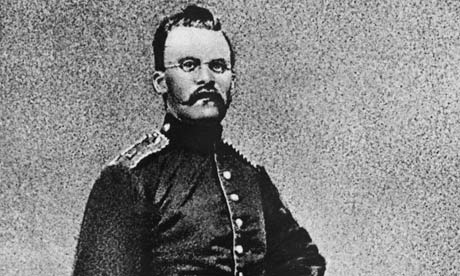 |
Friedrich
Nietzsche in Military Uniform
A rare
photograph of Friedrich Nietzsche as a soldier in the Prussian army, taken in
1864. Photograph: Bettmann/Corbis
|
"So, "God is dead": you, men of power, can't take his name in vain to shore up your institutions. That would be the political message."
Friedrich Nietzsche heralds the "death of
God" poetically in his Zarathustra book of 1884, and returns to it as a
philosophical dictum in The Antichrist (1888). By philosophical I mean this
wasn't an atheist broadside against belief and believers of the kind we've
become accustomed to in our own time – or, not only. It was an attack on the
tight association of reason and divinity, which had begun with Plato and
carried through the Christian tradition until René Descartes in the 17th
century.
In Descartes's "first philosophy" the
subject must doubt any "truth" available to him in the world, unless
he can prove it rationally. Descartes finessed his method with six proofs of
God ensuring reason's access to truth. But his peers could see that whether or
not God existed was irrelevant to the new scientific method.
However, while Descartes's scientific revolution and
the Enlightenment – which established rationality as the driving force of
general culture – pushed God out of the picture in France (and, with David
Hume, in Britain too), in Germany, where a unique kind of philosophy emerged at
the end of the 18th century, God still headed up systematic explanations of man
and nature and the meaning of life. A version of God made the great systems of
Hegel and Schelling, known together as German idealism, possible.
Nietzsche, as a mid-19th-century German philosopher,
first declared God dead in the context of this idealism. He might just as well
simultaneously have declared "reason" dead. Indeed, he did just that.
For reason, in the idealist context, was not just some capacity of mind to
prove propositions about experience true; it was, for Hegel, a supernatural
force out there, moving the world towards progress. Nietzsche's rebellion was a
way of saying that no great metaphysical forces governed human life and created
a framework for meaning, every individual faced the possibly absurdity of
existence alone. Yet this was hardly the only meaning of his "death of
God".
Nietzsche was as much a German writer as he was a
philosopher. His father, who died when he was four, was a Protestant minister,
and Nietzsche was brought up in an atmosphere of gloomy Lutheran piety by his
mother and sister. It was against the oppressive weight of Christian moralising
on his sensual being that he passionately rebelled; and this rebellion was
fired all the more by chronic illness, which further limited his chances to
love life.
To this personal rebellion must be added a Nietzschean
fury with the condition of a Germany newly united under Bismarck, who was
pursuing an official "cultural struggle", a kulturkampf, to unify
German culture as Protestant and national. Nietzsche despised the church as an
institution and politically and culturally he was a free-thinking European far
ahead of his days.
So, "God is dead": you, men of power, can't
take his name in vain to shore up your institutions. That would be the
political message.
So, "God is dead", which means
"Reason" with a capital R, the force out there that made possible the
philosophy of Plato, of the intertwining of Reason and divinity throughout
mainstream Christianity and western philosophy, cannot be used to explain the
nature of "man". But that means that man, too, is dead. In fact, the
most serious outcome of Nietzsche's death of God is the death of man, or
mankind, as one entity, defined by rational capacity and slotted into a vision
of "rational" progress.
So, "God is dead", but that means, for
Nietzsche, on the plus side, that the body is free. And the place where you
need to look for how to respond in Nietzschean style to the death of God is
back to his Die fröhliche Wissenschaft (1886), which I would translate as
"The Science of Joy". Here's a taste from the second preface
Nietzsche wrote to it:
"The unconscious disguise of physiological needs under the cloaks of the objective, ideal, purely spiritual goes to frightening lengths – and often I have asked myself whether, taking a large view, philosophy has not been merely an interpretation of the body, and a misunderstanding of the body."
Book three contains dicta such as "Prayer has
been invented for those people who really never have thoughts of their own and
who do not know any elevation of the soul …" and "The Christian
resolve to find the world ugly and bad has made the world ugly and bad".
God is dead now moves towards the idea that each man must reinvent himself as a
connoisseur of that very joy in living, which Christianity repressed.
So, God is dead: the awfulness of men killed him –
this is a theme, and the spirit of, much of the Zarathustra book. It makes the
message mournful, too.
Against it the explosion of playfulness in The Science
of Joy sets humanity the – perhaps impossible – task of complete
self-reinvention in order to live truly here, in this world.
The context in which this reinvention had been taking
place since before Nietzsche was "materialism", which, in the
philosophical sense, was the position opposite to the idealism of Hegel and
Schelling. Ludwig Feuerbach set it out in the 1830s, and this, as is well
known, gave Marx his philosophical starting point.
This is not to say Nietzsche is a Marxist. Far from
it. But it means that even his thinking did not come into being ex nihilo. He
was carried forward on the most radical spirit of the times in which was born,
and which he lived through in his own way: as a German writer, as an
anti-idealist and an anti-Christian. The title of his book Der AntiChrist, in
German, means "Anti-Christian" just as much as it means
"Antichrist".
The other narrative that already in the mid-19th
century told the western world God had died was, of course, Darwin's. Nietzsche
was not part of post-Darwinism, but what he had to say fed into the
20th-century "after God" cultural steam.
Most important when we consider him in the context of
today's atheists is to remember that he didn't elevate reason to a god either,
and that his involvement in the spiritual tradition he was trying to leave was
intense.
*********************
by Dr Roy Jackson
In The Gay Science, published in 1882, Nietzsche
introduces the character of a ‘madman’ who enters a busy market place and asks,
‘Where is God?’ The madman is mocked by the people in the market, which causes
him to say, ‘We have killed him, you and I.’ What Nietzsche means when the
madman says we have killed God is not that God is literally dead, but that our
belief or need for God is dead. The so-called ‘madman’ is only seen as mad by
the common people, but for Nietzsche he represents the philosopher – such as
Nietzsche himself – who realizes that we no longer truly believe in God and
that we must urgently face the consequences of this moral and spiritual gap in
our lives. With the death of God, mankind is looking for something to replace
Him, and Nietzsche’s writings are littered with criticisms of these new
replacements, including scepticism, nihilism, feminism, democracy,
utilitarianism and scientific positivism. Although Nietzsche is also critical
of religion, it is more the modern condition, or ‘modernity’, that he finds
unsatisfactory. In fact, Nietzsche – rather like the madman – was in many ways
sincerely religious and spiritual, for religion can provide a vision and
meaning to life. But the people of Nietzsche’s time have replaced God with a
faith in science or other modern ‘-isms’ which fail to provide us with the same
kind of meaning. Nietzsche’s spirituality calls for a rebirth, for an
appreciation of earthly life and nature, represented by the Greek god Dionysus.


No comments:
Post a Comment