
Move clears way for Sam Rainsy to return home from exile and campaign in this month's election
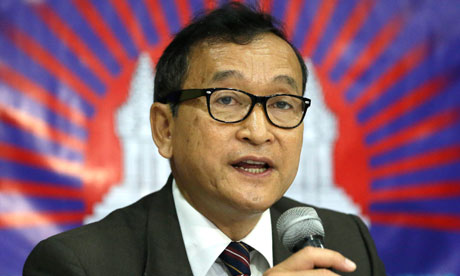 |
| Sam Rainsy has lived abroad since 2009 to avoid a prison term on charges widely seen as politically motivated. Photograph: Bullit Marquez/AP |
'For Hun Sen, the move pre-empts some of the criticism that the election is unfair. He has used similar tactics before, pressuring his opponents until they were in disarray, then making conciliatory gestures at the last minute.'
Associated Press in Phnom Penh
guardian.co.uk, Friday 12 July 2013
Cambodia's prime minister, Hun Sen, has engineered a
pardon for his most prominent rival, who has been in self-imposed exile for
four years, clearing the way for him to return home and campaign in this
month's general election.
The US and others had said the exclusion of Sam Rainsy
would call into question the legitimacy of the vote, scheduled for 28 July. His
return is not likely to greatly affect the big picture at the polls, where Hun
Sen appears assured of extending his 28-year rule.

Sam Rainsy has lived abroad since 2009 to avoid an
11-year prison term on charges widely seen as politically motivated. King
Norodom Sihamoni pardoned him on Friday at Hun Sen's request.
Hun Sen's letter to the king said the pardon should be
granted "in the spirit of national reconciliation, national unity and to
make sure the national election process is conducted under the principle of
democracy with freedom and pluralism and jointly by all involved parties".
Yim Sovann, a spokesman for Sam Rainsy's Cambodia
National Rescue party, said the exiled leader would return soon but did not
elaborate. The pardon came shortly after Sam Rainsy declared that he planned to
come back before the election, which suggests a deal may have been struck.
Hun Sen's cabinet spokesman, Phay Siphan, said the pardon
had nothing to do with the election or international pressure. "The prime
minister did it for the sake of the country and in the spirit of national
reconciliation," he said. "Sam Rainsy is free now. He can come back
to Cambodia. We welcome him back."
The pardon would appear to benefit both Sam Rainsy and
Hun Sen, long-time bitter rivals. Though the former is seen as the sole
Cambodian politician with the charisma and resources to present any real
challenge to the well-entrenched prime minister and his Cambodian People's
party, Hun Sen is still expected to win in a landslide.
A return would provide at least a morale boost for Sam
Rainsy's party, which has been greatly handicapped by its leader's absence. The
independent political analyst Chea Vannath said: "His presence will not
make much difference in terms of the election results. But I can say his
presence will reassure voters that he is coming back to stay with them, which
will warm the hearts of his supporters."
The opposition was dealt a blow last month when 28 of its
MPs were expelled from parliament after a committee run by Hun Sen's party
ruled they had broken the law by running for re-election under the banner of
the recently established Cambodia National Rescue party and not those under
which they had won their seats.
They can still run in the upcoming election, but without
parliamentary immunity. Immunity from arrest is a great benefit in Cambodia's
highly contentious elections, and those without it are at risk of being charged
with defamation for remarks seen as critical of Hun Sen and his government.
For Hun Sen, the move pre-empts some of the criticism
that the election is unfair. He has used similar tactics before, pressuring his
opponents until they were in disarray, then making conciliatory gestures at the
last minute.
Sam Rainsy went into exile after he was convicted and
sentenced to two years in prison for moving border markers at the frontier with
Vietnam, seven years for spreading false information about the border with
Vietnam and two years for defaming the foreign minister, Hor Namhong, by
associating him with the genocidal Khmer Rouge regime of the late 1970s.
One of Sam Rainsy's political tactics is to appeal to
Cambodian nationalism by speaking out against Vietnam, the country's
traditional enemy. Hun Sen enjoys good relations with Hanoi, which helped
install him in what was then its proxy regime after it invaded Cambodia to oust
the Khmer Rouge in 1979.


No comments:
Post a Comment