
A united opposition takes aim at one of Asia’s strongest
ruling parties
The Economist Jul 13th 2013 | SIEM REAP
SUPREMELY confident that his Cambodian People’s Party
(CPP) will romp to yet another handsome majority in the general election on
July 28th, Hun Sen, the prime minister, is hardly bothering to campaign
himself. His ministers and minions do it for him, spreading out across the
country to mobilise one of the region’s most formidable grassroots political
organisations.
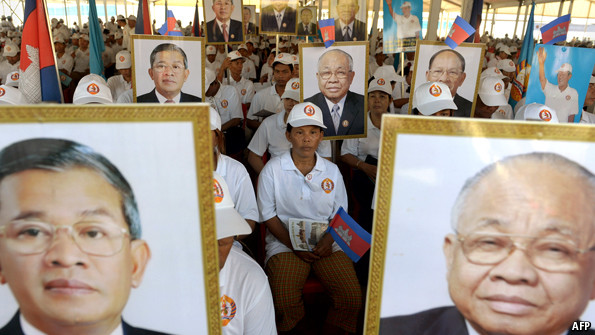
On the face of it, Mr Hun Sen (pictured, above, on the
placard on the left) has every reason to be relaxed. At only 61 and in power
since 1985, he is already Asia’s longest-serving prime minister. His party
enjoys all the advantages that come with monopolising state power for decades:
a captive government bureaucracy, near-total control of the media and mountains
of cash. The CPP has increased its seats in Parliament in every election since
democracy was fully restored in 1998, winning 90 out of 123 seats at the most
recent election. Along the way Mr Hun Sen has used violence, and now more often
the courts, to quash dissent and scatter any opposition. His reputation as a
strongman does not seem to bother him. Though he provokes criticism from
Western politicians and human-rights groups, China takes pains to flatter him.
This time round, however, the CPP is not having it all
its own way. A whiff of genuine competition is in the air, mainly because the
usually fissiparous opposition has managed to come together as the Cambodian
National Rescue Party (CNRP). It combines the parliamentary strength of the
well-established Sam Rainsy Party (26 seats in Parliament) with the Human
Rights Party (HRP), founded only in 2007. The HRP won just three seats at the
last election, but is strong at the local level.
As important, the CNRP’s leader, Kem Sokha, a veteran
activist, is proving a most effective campaigner. When the government recently
tried to stop local radio stations from rebroadcasting Khmer language foreign
programmes (from the likes of Radio Free Asia), it was a thinly veiled attempt
to take Mr Kem Sokha off the air. These stations are how he reaches the people
in the countryside who make up the majority of voters. Embarrassingly, the
government quickly had to back down after a deluge of domestic and foreign
protests. Mr Kem Sokha has rattled Mr Hun Sen, who is usually imperturbable.
Indeed, Mr Kem Sokha has the prime minister’s touch of
being able to talk to poor farmers and stallholders about economic matters in
ways that they understand. Unlike Mr Hun Sen, however, he is very visibly on
the campaign trail, visiting a fresh province almost every day. Denied access
to the media, and with low internet penetration in Cambodia, his is an
old-fashioned kind of campaign, involving bellowing his message through a
megaphone from the back of a pickup truck. His supporters love it. He draws
large crowds as he takes the fight to Mr Hun Sen’s home turf of the
countryside, challenging the supposed economic success there.
Mr Hun Sun’s chief appeal to the country’s 9m or so voters
is what one veteran observer sums up as “stability and roads”. Given Cambodia’s
history, it is a compelling combination. The CPP argues that after the terrible
decades of the 1970s, 1980s and 1990s—of Pol Pot and the genocidal Khmer Rouge
regime followed by a Vietnamese invasion and then civil war—it was the party
that brought peace to the country. And with that peace has come a palpable
prosperity: last year GDP grew by over 7%. It has enabled the government to
embark on a big programme to boost infrastructure, helped by the Chinese. In a
poll of Cambodians earlier this year, America’s International Republican
Institute found that 79% of respondents thought that the country was heading
“in the right direction”, while 74% said that this was because more roads were
being built, allowing farmers to take their rice to market, for example. The
economy would seem to be Mr Hun Sen’s strong suit, therefore.
Hun Sen’s road
Sensibly, the opposition does not dispute the economic
growth. Rather, it argues that the benefits of the boom go to an ever smaller
elite consisting of the families of Mr Hun Sen and his cronies. It taps into a
widely held belief that Cambodia is growing more and more corrupt, and that Mr
Hun Sen’s rule is becoming alarmingly dynastic. All three of his sons play big
roles in the regime, and one, the head of the CPP’s youth wing, is now running
for a seat in Parliament.
To redress the economic imbalance, the CNRP proposes a
populist programme borrowed, in parts, from a former Thai prime minister,
Thaksin Shinawatra (who happens to be a chum of Mr Hun Sen). Mr Kem Sokha
promises an old-age pension of $10 a month and a minimum wage of $150. The
costs of such programmes appear to have been badly thought out, if at all. Such
is the luxury of opposition.
The CNRP says that for the coming election the voter
rolls have been fiddled, and that the government will also find other ways to
cheat. Still, the opposition’s cause will be helped if a long-exiled leader,
Sam Rainsy, returns before polling day, as he has promised. He fled the country
in 2005, facing several charges, all politically motivated, he claims. If he
returns, the police vow to arrest him at the airport. That would prevent Mr Sam
Rainsy from campaigning. But his incarceration would be even more valuable to
the CNRP, as a symbol of Mr Hun Sen’s intolerant ways.


No comments:
Post a Comment