
Khmer Circle:
It's a narrative with which most western observers and pedantic cranks are comfortable with. After all, didn't the Vietnamese invade Cambodia in 1978 to end the "murderous Pol Pot regime", and the ruling state they installed since, though hardly perfect, is no where as murderous or totalitarian as the one it has replaced? Even Sihanouk felt that "his people" had a better life than they had had under Pol Pot!
There are other reasons for this die-hard narrative, and some among its converts even describe Ho Chi Minh as an "internationalist" for his supposed "anti-colonialist" stance. Poor Ho ["One who enlightens"]; the man who changed his ideological allegiance as often and as expediently as anyone changes his underpants!
What legacy such a lazy and misplaced narrative leaves among many outsiders today over Cambodia's current crises and predicaments is the general ambivalence and rather selective understanding that for whatever challenges and threats confronting the country, its people are the main causes of their own woes and misfortunes, i.e. they have only themselves to blame! "Blame" anyone else - certainly not the Vietnamese, not even so much as referring to them as "yuon"! - and the Cambodians are indulging in their petty 'blame game'.
Let's put it this way: Are there still "mixed opinions" among the descendants of the ancient Cham kingdom scattered across the region today? And if there are such divergent views over their 'history', how much do they really matter now that they are officially stateless - if at all?!
Don't forget to cling to the narrative that the Vietnamese are the good guys in all of this [after all, they are being inducted into the anti-China alliance in a potential confrontation between the rest of the civilised world and their rising and threatening northern neighbours]. Any thing else is baseless irrelevance...
&&&
02 April 2018
Sok Khemara
VOA Khmer

Association for Asian Studies Annual Conference in Washington DC, March 22-25, 2018.
Vietnam invaded Cambodia in January 1979 with about 200,000 troops to overthrow the Khmer Rouge regime, which had ruled since 1975.
“Vietnam’s ambition was still the same ... But if they sent troops to fight and occupy, it would contradict the Paris Peace Accord of 1991, so they only sent spies ... to dissolve Cambodia without using weapons to shoot us,”
WASHINGTON DC —
A Cambodia researcher has said that Vietnam took a risk by supporting Prime Minister Hun Sen but saw him as an intelligent and capable leader who could support their narrative of liberation from the Khmer Rouge.
Hoang Vu, a Ph.D. candidate at Cornell University, told the audience at the annual Asian Studies Conference in Washington, DC last month that Vietnam had stayed in Cambodia for a decade “to justify that narrative, the original narrative, that they had come to liberate the country.”
“It’s in Vietnam’s best interests that the government of the Peoples Republic of Kampuchea succeeds, succeeds in keeping the Khmer Rouge from coming back to power, succeeds in rebuilding the country, and they needed a capable leader to do that even if they had to take risk on him,” Vu told VOA Khmer after the presentation.
Vietnam invaded Cambodia in January 1979 with about 200,000 troops to overthrow the Khmer Rouge regime, which had ruled since 1975. Vietnamese forces eventually withdrew in 1989.
Vu said, in the beginning, the Vietnamese authorities gave priority to known entities who they could trust, later supporting the current prime minister, Hun Sen, despite his youth.
“I think with Hun Sen, the Vietnamese government made a big gamble. They understood that this was somebody who is very smart. I mean even though he was 27 years old at the time, they were comfortable making him Minister of Foreign Affairs. He’s very eloquent and clearly very ambitious and knew how to get power and to keep power in all sorts of different situations,” Vu said.
He said that choice had proved interesting as Hun Sen was evidently a more independent figure than those who went before him and more willing to make decisions that were not in Vietnam’s immediate self-interest.
“Vietnam made the right decision to back a leader like him. I mean it’s not just only him, Heng Samrin, and other leaders. And knowing this risk because ultimately a credible and stable Cambodia at least does not oppose Vietnam, that is the minimum condition and we have achieved that,” Vu said. “The current Cambodian government is not indebted to VN in that way, is not controlled by VN, but it’s not actively opposing VN.”
“You know Hun Sen has a huge social media presence. He has built connections in all levels of government and certainly in the past few years he has somewhat upset the traditional balance of the ruling factions within the CPP and upset that in the sense that he has gained complete control of the CPP and of course of the Cambodian state as well.”
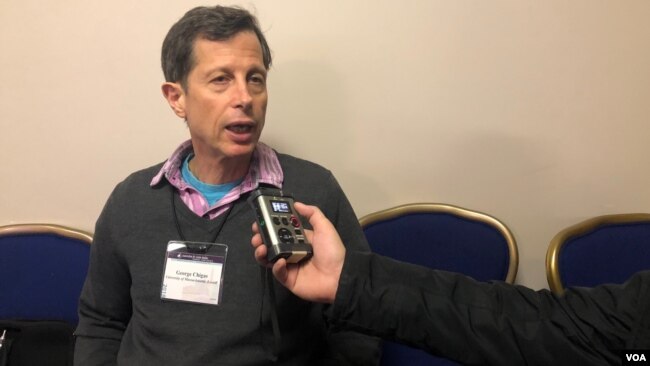
Professor George Chigas of Cultural Studies at the University of Massachusetts Lowell spoke to VOA Khmer at the Annual Conference for Asia Studies from March 22-25, 2018, Washington, D.C. (Photo: Sok Khemara/VOA Khmer)
Professor George Chigas, another participant, told VOA Khmer that Vu’s argument that Vietnam was not motivated to create a vassal state in Cambodia, but also not acting altruistically, was convincing.
“It wasn’t acting just to save the Cambodian people, it had some other motivations as well,” Chigas said.
Many Cambodians, however, disagree with Vu’s take on this period of Cambodia’s modern history.
Prak Sereivuth, executive president of the Khmers Kampuchea-Krom Federation, a pressure group, said the failure of the Soviet Union was the main driver behind Vietnam’s stunted ambitions in Cambodia.
“Vietnam’s ambition was still the same ... But if they sent troops to fight and occupy, it would contradict the Paris Peace Accord of 1991, so they only sent spies ... to dissolve Cambodia without using weapons to shoot us,” he said.


No comments:
Post a Comment