
Editorial by Khmer Circle:
Sometimes, one just wonders whether regional news outlets like this one are in fact a front for the Phnom Penh regime or its Hanoi mastermind. As a matter of fact, most observers and critics - including even opinions hostile to the Hun Sen regime - have attacked the CNRP opposition's leadership for its perceived failure to do precisely what is being suggested by this commentator: 'agitate' their supporters into action at critical moments such as in the aftermath of the opposition's illegal dissolution and the mid-night arrest of its co-leader Kem Sokha.
However, the usual sneer has been aimed at CNRP's acting president Sam Rainsy for his 'theatrical gestures' and 'cowardly' tendency to "flee" his country, abandoning his mass followers in the process at the first sign of trouble to the mercy of Hun Sen's retaliatory measures.
The examples provided by experience of countries and peoples around the world, and particularly, in the Middle-East in recent years can serve to remind us just how violent or costly the process of transition or change from authoritarianism to civilian rule can be. This Cambodian regime has also committed numerous atrocities down the years against numerous groups and figures - including Sam Rainsy and his civilian supporters - who had only called for peaceful change or reform in accordance with their constitutional rights and duty as citizens. The tendency of the ‘Strongman’ to resort to violence and crackdown against instances of such peaceful protests says as much about the illegitimate nature of his rule and power, namely his acknowledgement of the reality that this rule and power do not rest with the will of the vast majority of the Cambodian people. Killing and harming the long-suffering civilians and supporters of opposition groups – even for minor shows of protest – also serve as a warning to that same majority and ensure they stay intimidated – especially when ‘agitated’ against him.
Still, if the CNRP leadership [and this is not by way of an apology for this leadership] agitates and galvanises its followers into any form of confrontation with the regime and be met with brutality and violence in the attempt, the leadership will be damned, but if it fails to do so out of regard for the lives and limbs of the same people, then the leadership will also be damned too!
Yet, the notion that any political manoeuvring by the leaders of the now banned CNRP is a cynical and irresponsible attempt to land their ordinary in-country supporters in further trouble is hardly new. In the wake of Sam Rainsy’s recently announced plan to return to Cambodia, Sok Eysan - the regime’s eminent spokesman - told RFA that Rainsy’s move is intended to force his ‘government’ to make more arrests of his supporters back home so as to turn domestic and international opinions against the government!
By Luke Hunt
September 30, 2020
Diplomat
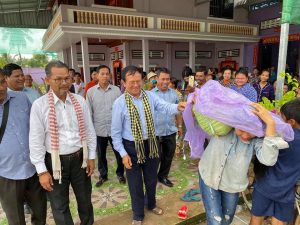
Credit: Facebook/Kem Sokha
"Over the coming three years, that can only spell further trouble for their in-country supporters, who have long borne the brunt of their political agitation."
From his exile in France, interim CNRP leader Sam Rainsy has said he will make another attempt at entering Cambodia after a similar bid — including promises to lead protests across the country – failed late last year.
Meanwhile his party’s leader Kem Sokha, who is technically under house arrest on treason charges, has traveled out into the countryside to hand out humanitarian assistance to those affected by the annual monsoon flooding, and to attend religious ceremonies for the Pchum Ben festival earlier this month.
Sokha has previously been warned that leaving his home could put him in breach of the conditions laid down by the courts, which have allowed him to transfer from prison to his home in the capital Phnom Penh while his case is being tried. Those conditions were relaxed in November.
In storm-hit provinces, Kem Sokha distributed rice, raincoats and food and thanked those who have donated money and supplies for flood-affected communities. But Sokha’s activities have left former colleagues who defected from the CNRP unimpressed.
Former CNRP lawmaker Ou Chanrath told the government-friendly Khmer Timesthat he believed Kem Sokha, who is being closely monitored by international human rights groups, had left the capital with a hidden agenda.
“Before, he had no suitable reason to gather people, but now he has reasons, such as attending the Pchum Ben festival and donating food to the people during the flood season,” he said.
“I think he wants to remind his [supporters] that he will return to the political arena in the near future,” Chanrath added. “He could test the reaction from people whether they still support him or not.”
That support is difficult to determine in a country that discourages opinion polls.
At the ballot box in 2013, the CNRP drew more than 45 percent of the vote, which shocked the long-ruling Cambodian People’s Party (CPP).
The CNRP claimed the poll was rigged and refused to accept the result. As opposition supporters took to the streets, the party’s elected representatives declined to take their seats in parliament. Hun Sen subsequently alleged that the party was trying to foment a color revolution and justified a crackdown ahead of elections in 2018 on national security grounds.
CNRP politicians and supporters fled the country or were jailed while the party was dissolved by the courts and Hun Sen won all 125 seats in the National Assembly. The crackdown continues to this day amid ongoing spotfire protests.
Inside Cambodia, the situation is potentially volatile, with Sam Rainsy goading Hun Sen from abroad, particularly over the state of the economy, which has deteriorated amid an exodus of Western business and the recent withdrawal of some trade preferences by the European Union.
The COVID-19 pandemic tipped the country, like much of the world, into a deep recession described by Sam Rainsy as an “economic crisis” that made his return necessary.
“I will return to Cambodia to solve the economic crisis,” he recently told Radio Free Asia’s Khmer Service. “Hun Sen doesn’t know how to solve this crisis. He and his government don’t know how to do it.”
He said Cambodia’s problems could only be solved through when “power is returned to the people,” adding that he would ask the EU to restore the trade perks and says he’ll put an end to the crackdown on the CNRP, civil society groups and the independent media.
The next election is not until 2023 and the idea that either CNRP leader will be allowed to contest the poll is fanciful at best, but its leaders retain a proven ability to stir the pot from afar (or even from behind bars) and cast international doubts over the prime minister’s legitimacy.
Over the coming three years, that can only spell further trouble for their in-country supporters, who have long borne the brunt of their political agitation.
Authors
Luke Hunt
Contributing Author
Luke Hunt
Luke Hunt is a Southeast Asia correspondent for The Diplomat and has worked in journalism for more than 25 years.


1 comment:
It is time for Khmer people to take risk by mounting a mass peaceful protest demanding for the restauration of the constitution, the reinstatement of the CNRP. and free all wrongfully accused political prisoners.
No blood, no glory.
Post a Comment