
PUBLISHED : 3 Nov 2025 at 01:01
WRITER: Veera Prateepchaikul
BKP
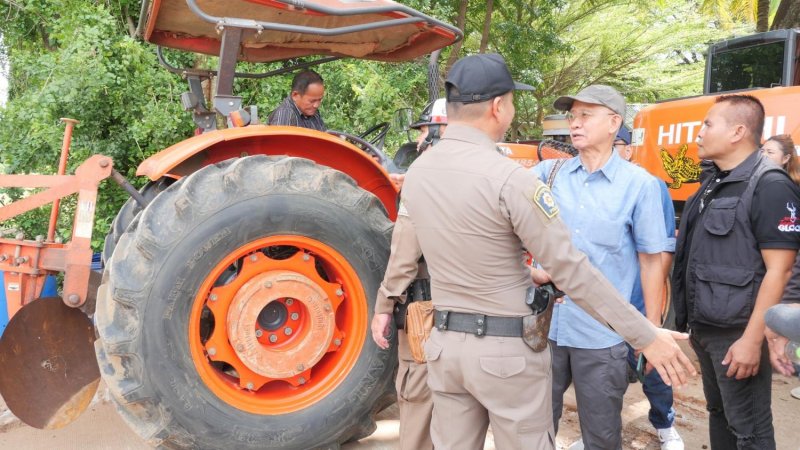
A photo taken on Friday shows activist Veera Somkwamkid
campaigning to evict Cambodians living in Ban Nong Chan of Sa Kaeo. The
village is home to many Cambodian refugees, who have been living in the
area for decades. (Photo: Biew Sue-Issara)
A slip of the tongue has put Prime Minister Anutin Charnvirakul in hot water. Here is what he was quoted to have said that provoked the emotions of anti-Cambodia, ultra-nationalist groups.
"For the sake of fairness, both sides [Thailand and Cambodia] must be fair [with each other] and we could reach an agreement. There are those of us who encroached [on Cambodian land], we must pull them back and the Thai government will have to find a land for those who had encroached on Cambodian soil. Likewise, Cambodia must do the same."
Had Thailand and Cambodia been on friendly terms, such a remark by Mr Anutin would have been treated as reasonable and ignored. But because the two countries are still reeling from the limited but bloody war that took place over five days in late July, the remark by our prime minister was tantamount to pouring fuel into fire among the hardline nationalists. It also amounted to an admission that Thailand has trespassed on Cambodian soil.
It was not surprising that the hardliners are fuming at the prime minister, with some accusing him of selling off Thai territory to Cambodia. Anyone with common sense would be concerned the remark could be exploited by Cambodian media for Cambodia's benefit in future talks on disputed land between the two countries, specifically Ban Nong Chan and Ban Nong Ya Kaew border villages in Sa Kaeo's Khok Sung district.
Upon his return from the Apec summit on Saturday, the prime minister offered a public apology for his comments regarding the border conflict. This unfortunate incident should serve a reminder to him and other senior government officials to be cautious about making statements on territorial issues pertaining to Cambodia.
Ultra-nationalist groups already felt betrayed by the Anutin administration, who ignored their calls to scrap the Joint Boundary Commission (JBC) meeting with Cambodia before the Association of Southeast Asian Nations (Asean) Summit in Kuala Lumpur on Oct 25-28. They said attending the meeting may constitute recognition of MoU 43 and will deprive Thailand of the right to terminate the agreement.
The hush-hush manner with which Cambodia sued for a peace deal with Thailand at the Asean Summit with the intervention of US President Donald Trump, was intended to save the regime led by the Hun family, rather than the genuine desire for peace and friendly relations with Thailand.
The regime is crumbling under the weight of economic hardships which may, eventually, lead to the country's economic collapse -- especially in light of closures of their border with Thailand, the regime's own short-sighted policy to urge almost one million Cambodian workers in Thailand to return home with promises of non-existing decent jobs, and the boycott of Thai products.
International pressure on Cambodia over the regime's cozy relationship with Chinese scam tycoons and its decision to turn a blind eye on the hundreds of scam centres across the country, particularly in Sihanoukville and Poipet, have made it impossible for the Hun Sen-Hun Manet regime to sit idly by.
Nonetheless, its response seems to be half-hearted as although some scam victims were rescued, only the small fry were caught while the big fish remain free. Recently, 80 South Korean nationals were rescued after the government in Seoul took decisive action against Cambodia following the death of a South Korean student who was tortured by scammers.
Further complicating the issue was the signing of a MoU between Thailand and the United States on critical minerals or rare earths on the sidelines of the Asean Summit. Nationalist and environmental groups did not hesitate to point an accusing finger at the Anutin administration for "selling out" Thailand's critical minerals to the US, although their reactions seem to be based on nationalistic sentiments, as opposed to scientific approaches.
According to the Department of Primary Industries and Mines, Thailand's critical mineral deposits are scattered across the country and are not concentrated in specific areas, making their extraction not commercially feasible. Lack of modern technology in extraction and processing of rare earths is also a problem and requires foreign cooperation.
It is sad that many Cambodians are suffering and lack the freedom to air their dissent against the ruling regime. Yet it is important for Thailand not to take any steps which may legitimise the Hun Sen-Hun Manet regime, such as reopening of the borders with Cambodia. Seen in this context, the actions of ultra-nationalist figures, such as activist Veera Somkwamkid who rallied Thai protesters to evict illegal Cambodian settlers from Bang Nong Chan, could be seen as too radical and may escalate border tensions. They should leave the matter to troops and officials on the ground, even though it may take some time.
Nonetheless, their actions serve as warning to the government not to rush into embracing Cambodia and to hope that relations will remain the same before the armed conflict.
Thai-Cambodian relations will never be the same as long as the Hun Sen-Hun Mant regime remains in power. How can we trust a regime that lets criminals use its territory as a haven for transnational scam syndicates who are enslaving tens of thousands of people of various nationalities and robbing victims throughout the world with impunity, in exchange for a sizeable cut of the filthy money to enrich their family and the Cambodian elites?


No comments:
Post a Comment