
The ASEAN chair says that the two nations’ prime ministers “reaffirmed their commitment to pursuing a peaceful resolution.”
By Sebastian Strangio
November 14, 2025
November 14, 2025
Diplomat
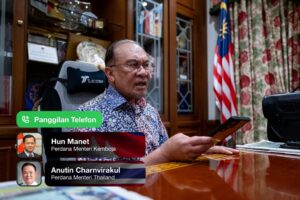
Malaysian Prime Minister Anwar Ibrahim speaks by phone with Thai Prime Minister Anutin Charnvirakul and Cambodian Prime Minister Hun Manet, Nov. 13, 2025.
Credit: X/Anwar Ibrahim
Credit: X/Anwar Ibrahim
Malaysian Prime Minister Anwar Ibrahim has spoken with Thai Prime Minister Anutin Charnvirakul and Cambodian Prime Minister Hun Manet in a bid to salvage the peace accord agreed in Kuala Lumpur on October 26.
Recent clashes have threatened to derail the Joint Declaration, which was intended to end the border dispute that erupted into open conflict for five days in July, killing at least 43 people and displacing more than 300,000 civilians on both sides of the border.
In a social media post yesterday, Anwar, who holds the chairmanship of the Association of Southeast Asian Nations (ASEAN) until the end of the month, said that he spoke to the two leaders by phone yesterday, after the breakdown of the accord.
Both Anutin and Manet “provided positive feedback and reaffirmed their commitment to pursuing a peaceful resolution,” in line with the October 26 agreement, Anwar wrote.
“I reiterated Malaysia’s position that the friendship and ceasefire between both countries must be further strengthened in accordance with the agreement concluded in Kuala Lumpur last month,” he added. “I also conveyed Malaysia’s readiness to continue playing our role as a facilitator in charting this path towards peace.”
Under the October 26 agreement, which was signed under the supervision of Anwar and U.S. President Donald Trump, the two sides agreed to withdraw heavy weapons from the border area, undertake joint landmine clearance, and cooperate more closely to suppress online scamming operations.
However, Thailand suspended the implementation of the agreement on November 11, following a landmine explosion that injured four soldiers patrolling in a disputed area of the border close to Preah Vihear temple. The Thai military alleged that the mine had been freshly laid, presumably by Cambodian military personnel, the seventh such incident since July. As on all of those occasions, Phnom Penh denied laying the mine, stating that the area was littered with unexploded mines from the country’s civil war.
Two days later, one Cambodian civilian was reportedly killed and several others injured when Thai soldiers opened fire in a disputed frontier settlement on the border between Thailand’s Sa Kaeo province and Cambodia’s Banteay Meanchey province. Cambodia claims that the soldiers fired at the civilians unprovoked, while Thai officials maintain that Thai soldiers were responding to Cambodian troops who “fired shots into Thai territory.”
Malaysia’s Foreign Minister Mohamad Hasan said yesterday that Malaysia was ready to mediate between the two nations, who he said “have lost trust in each other,” in order to preserve the October 26 agreement. “They have contacted us. Cambodia has requested for the talk to be held in Kuala Lumpur and similarly with Thailand, who has requested that we continue with our effort to preserve the ceasefire,” he said, according to the state news agency Bernama.
Interestingly, despite an initial mistranslation of his comments by Bernama, Mohamad also stated that the landmine that detonated on November 11 had been freshly laid. “The ASEAN Observer Teams in Thailand and Cambodia reported that the landmines were new,” Hasan said, adding, “My hope is for both sides to calm down and to continue the peace talk.” His comment is consistent with the findings of an investigation published last month by Reuters, which concluded that previously uncovered landmines on the Thai-Cambodian border have likely been newly laid, rather than being remnants of Cambodia’s civil war.
Whatever the truth, Anwar’s intervention is a welcome attempt to prevent the current situation from spiraling back into open conflict. Whether it will succeed in preventing this, in either the short or long term, remains to be seen. As I noted at length yesterday, mistrust between the two sides remains high, and both governments face domestic nationalist pressure to maintain a hard line against the other. This is particularly the case in Thailand, where Anutin’s government remains beholden to the Royal Thai Army and cannot afford to take any conciliatory step toward Cambodia.
After the damage inflicted on the Thai-Cambodian relationship, the road back to stable relations, let alone any sort of comity, is likely to be a long one.


No comments:
Post a Comment