
Analysts warn relations are in a ‘fragile place’ as the neighbours trade barbs and leverage international law at a UN meeting in Geneva
scmpSam Beltran,
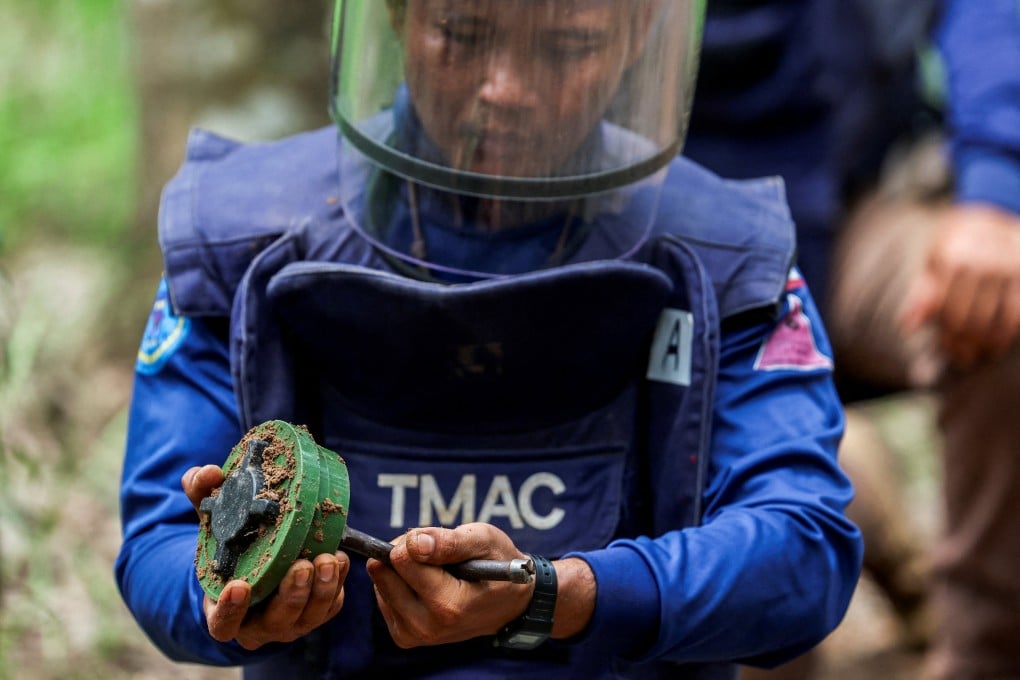
Thailand and Cambodia took their renewed border dispute to a United Nations forum on landmine prohibition in Geneva this week, each vying for international support as their ties continued to unravel.
Both governments used the meeting of the Anti-Personnel Mine Ban Convention, also known as the Ottawa Convention, to appeal to the international community.
Cambodian Senior Minister Ly Thuch met International Committee of the Red Cross vice-president Gilles Carbonnier on the sidelines of the week-long gathering, which runs from Monday to Friday.
He reportedly urged the organisation to closely monitor the condition of 18 Cambodian soldiers detained by Thai authorities, called for their immediate release and for Bangkok to uphold its commitments under bilateral agreements and international law.
Ly Thuch, who serves as first vice-president of the Cambodian Mine Action and Victim Assistance Authority, described the detentions as “unlawful”, noting that the soldiers had been held for 125 days as of Monday.
He also urged the Red Cross to apply stronger pressure on Thailand to comply with its obligations under the Cambodia-Thailand peace agreement.
Both governments used the meeting of the Anti-Personnel Mine Ban Convention, also known as the Ottawa Convention, to appeal to the international community.
Cambodian Senior Minister Ly Thuch met International Committee of the Red Cross vice-president Gilles Carbonnier on the sidelines of the week-long gathering, which runs from Monday to Friday.
He reportedly urged the organisation to closely monitor the condition of 18 Cambodian soldiers detained by Thai authorities, called for their immediate release and for Bangkok to uphold its commitments under bilateral agreements and international law.
Ly Thuch, who serves as first vice-president of the Cambodian Mine Action and Victim Assistance Authority, described the detentions as “unlawful”, noting that the soldiers had been held for 125 days as of Monday.
He also urged the Red Cross to apply stronger pressure on Thailand to comply with its obligations under the Cambodia-Thailand peace agreement.
Bangkok suspended that accord last month, blaming Phnom Penh for a landmine blast along their shared border that severely injured a Thai soldier.
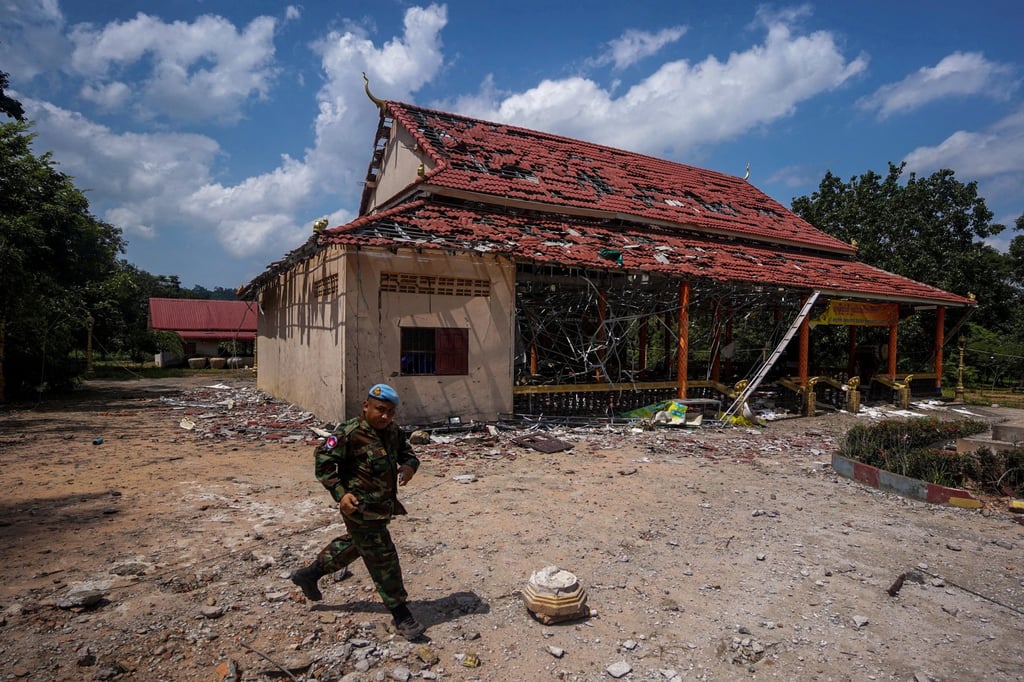
A Cambodian soldier walks past a building hit by artillery during a visit of foreign diplomats to inspect a damaged area along the Thailand-Cambodia border in August. Photo: Reuters
Thai Foreign Minister Sihasak Phuangketkeow, who is leading his country’s delegation in Geneva, said Bangkok would propose a fact-finding mission under the mine ban treaty.
Thai Foreign Minister Sihasak Phuangketkeow, who is leading his country’s delegation in Geneva, said Bangkok would propose a fact-finding mission under the mine ban treaty.
The renewed tension follows deadly clashes that flared in July across disputed stretches of the frontier, killing dozens on both sides. A truce brokered by Malaysian Prime Minister Anwar Ibrahim, in his capacity as Asean chair, led to a peace deal signed in the presence of US President Donald Trump at the Association of Southeast Asian Nations summit in Kuala Lumpur in October.
The ceasefire is precarious, however. Landmine blasts along the contested border continue to pose risks, severely injuring at least seven Thai soldiers since July 16.
Sihasak said Thailand would maintain its stance in dealing with Cambodia, even if doing so jeopardised trade negotiations with Washington.
“Unless the Cambodians take responsibility for laying new landmines, we will take this case to the international community,” he said, as reported by Nikkei Asia on Monday.
Thailand suspends Trump-backed peace deal with Cambodia
Ties in ‘a fragile place’
Analysts say the decision by both countries to invoke international law and UN mechanisms reflects their efforts to win diplomatic leverage and global sympathy at a time of deep mistrust.
Joanne Lin, a senior fellow and coordinator at the ISEAS-Yusof Ishak Institute’s Asean Studies Centre, said Thailand typically preferred bilateral approaches.
But she said Bangkok had gained confidence in raising the issue internationally after an Asean observer team reportedly supported its claim that new mines had been planted on its side of the border.
Cambodia, by contrast, has turned to legal and multilateral channels to press for the release of its detained troops and to highlight what it calls Thailand’s breach of commitments.
“When both countries start appealing to external legal mechanisms, it usually means bilateral talks are no longer seen as feasible or credible,” Lin said.
“It’s a sign that the dispute has moved into a more adversarial phase, where each side is building its case rather than resolving the problem. It doesn’t mean open conflict is inevitable, but it does mean the relationship is now in a very fragile place and will require sustained mediation to pull back from this trajectory.”
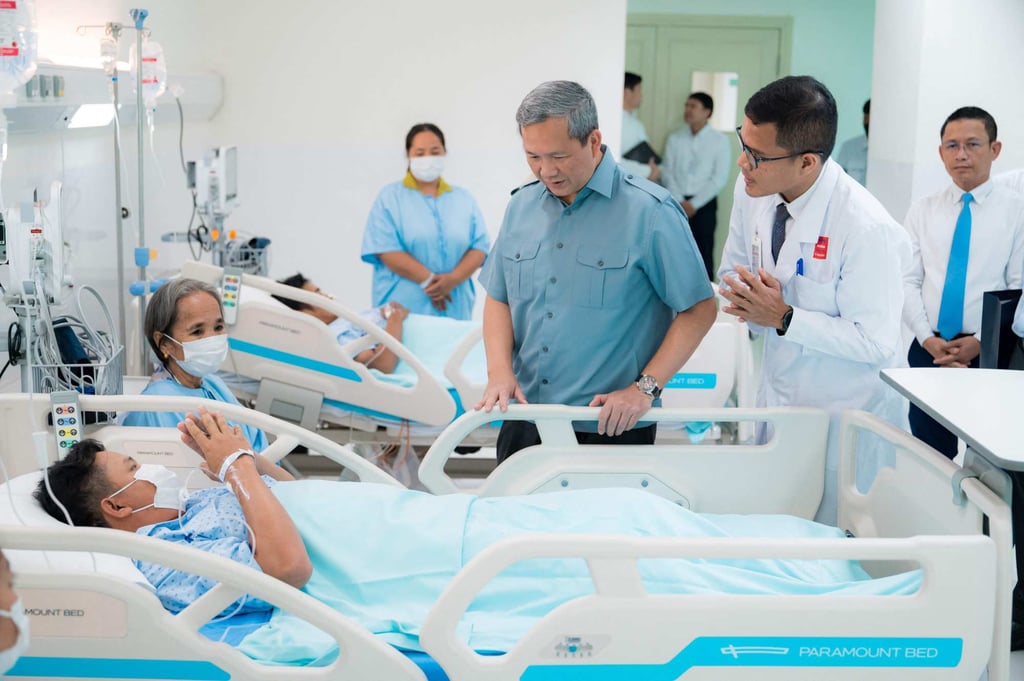
Cambodia’s Prime Minister Hun Manet meets a patient at a hospital in Phnom Penh who was injured along the Cambodia-Thailand border last month. Photo: Agence Kampuchea Press/AFP
Chhay Lim, deputy director of the Royal University of Phnom Penh’s Centre for Southeast Asian Studies, said Bangkok’s call for a fact-finding mission must comply with international law, with both sides properly informed and involved.
He added that Thailand’s stance should align with Cambodia’s move to seek intervention from the International Court of Justice (ICJ).
“If the international fact-finding mission is a sign of support for broader international law and UN mechanisms, then participation in the ICJ for dispute settlement follows the same logic,” he said.
Lin said Cambodia had long relied on international bodies such as the UN Security Council and the ICJ to handle disputes, embedding its arguments in established legal and diplomatic frameworks.
Thailand, by contrast, had usually favoured resolving issues bilaterally and resisted taking cases to global forums, so she said its decision to use the UN mine ban treaty now reflected an effort to press its current advantage on the landmine issue.
Chhay Lim, deputy director of the Royal University of Phnom Penh’s Centre for Southeast Asian Studies, said Bangkok’s call for a fact-finding mission must comply with international law, with both sides properly informed and involved.
He added that Thailand’s stance should align with Cambodia’s move to seek intervention from the International Court of Justice (ICJ).
“If the international fact-finding mission is a sign of support for broader international law and UN mechanisms, then participation in the ICJ for dispute settlement follows the same logic,” he said.
Lin said Cambodia had long relied on international bodies such as the UN Security Council and the ICJ to handle disputes, embedding its arguments in established legal and diplomatic frameworks.
Thailand, by contrast, had usually favoured resolving issues bilaterally and resisted taking cases to global forums, so she said its decision to use the UN mine ban treaty now reflected an effort to press its current advantage on the landmine issue.
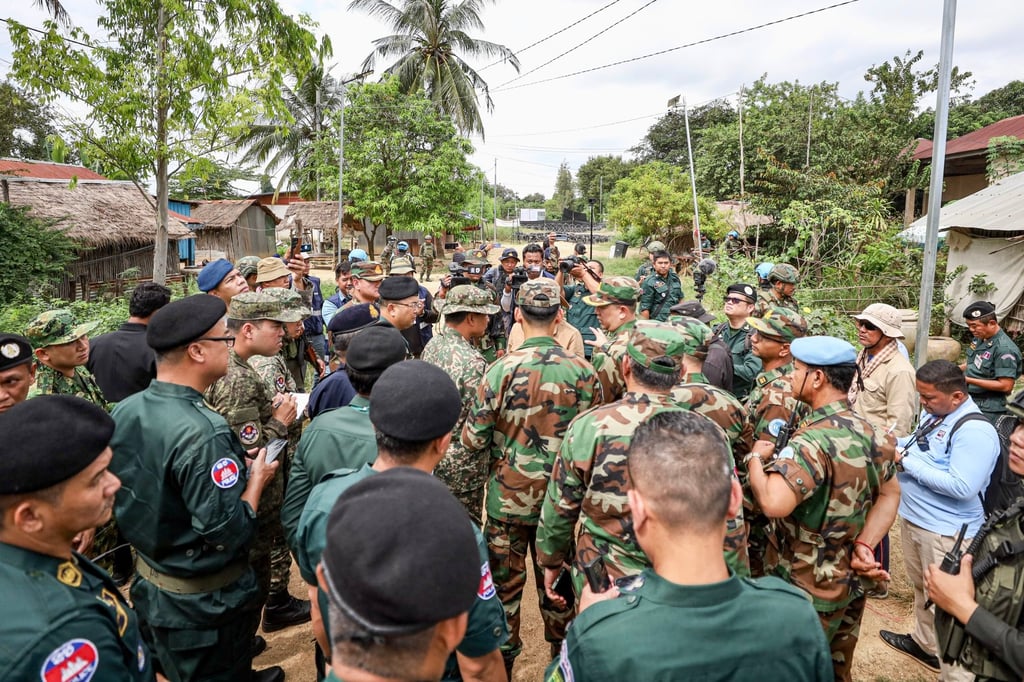
Members of the Asean observer team gather at a village for inspection in Banteay Meanchey province, Cambodia, last month. Photo: EPA
“So in terms of credibility and familiarity with international mechanisms, Cambodia enters this space with far more experience and established legitimacy, whereas Thailand’s move is more tactical and situational,” Lin said, adding that returning the issue to Asean-led mediation would be the most constructive path forward, with regional mechanisms verifying facts on the ground, supported by international channels if necessary.
Lin added that the Asean observer team should continue its border inspections and the Thailand-Cambodia Joint Boundary Commission should resume efforts to delineate the frontier.
“International mechanisms are an option, but only if both sides are willing to accept the findings,” she said. “Past experience … shows how difficult that can be.”


No comments:
Post a Comment