
-Social media
The Thais can't seem to see the distinction between 'defensive' presence and 'offensive presence' at all and use their feigned ignorance to bombard these sacred temple sites, including the Preah Vihear temple. Also these ancient temples happen to perch right on top of the mountain range which falls within Cambodia's legally legitimate sovereignty according to the Franco-Siamese treaties of 1904-1907 which Thailand continues to refuse to recognise even after the 1962 ICJ verdict on Cambodia's ownership of the Preah Vihear temple and its vicinity.
Accusing Cambodian troops of using these temples as "bunkers" has become the Thai military's favourite pretext for its callous destruction and desecration of these sacred sites, including the now severely damaged Preah Vihear temple which is listed as UNESCO's World Heritage Site. If there were no Cambodian troops stationed at all in these areas that fall within Cambodian sovereignty Thai troops would have simply walked into these areas without having to fire a single bullet, as they did in 1954 following the withdrawal of French colonial forces. The lightly armed Cambodian troops stationed at these temples for defensive purposes, moreover, posed no offensive threat to Thailand unless they were attacked first, mostly by Thai artillery and rockets.
This is not the first time either that Thailand showed such disregard or vengeance towards Cambodia's sacred sites. Following the 1962 ICJ judgement over the Preah Vihear dispute the Thai army reportedly used elephants to pull down several central columns of the temple in obvious show of displeasure and revenge. Why else would they bomb Ta Krobey and Preah Vihear temples or demolish the Vishnu statue in the area during and after the recent clashes?
These despicable actions could only speak of the moral depravity; callousness and barbarity of the perpetrators behind them while at the same time expose beyond any doubt the hypocrisy, lies and shamelessness of their apologists who are all too familiar on this site and other social media forums.
-Social media
***
At
first glance, the recent Nikkei Asia report on Cambodia’s annexation
fears along the Thai border reads as a familiar post-conflict human
story; displaced villagers, damaged homes, and families struggling to
return after fighting subsides. Yet a closer reading reveals something
more consequential. The article documents not merely the aftermath of
war, but a deeper problem “the fighting has stopped, but the situation
on the ground is still changing”.
The
most striking point in the Nikkei report is not what happened during
the fighting, but what happened after it ended. Following the December
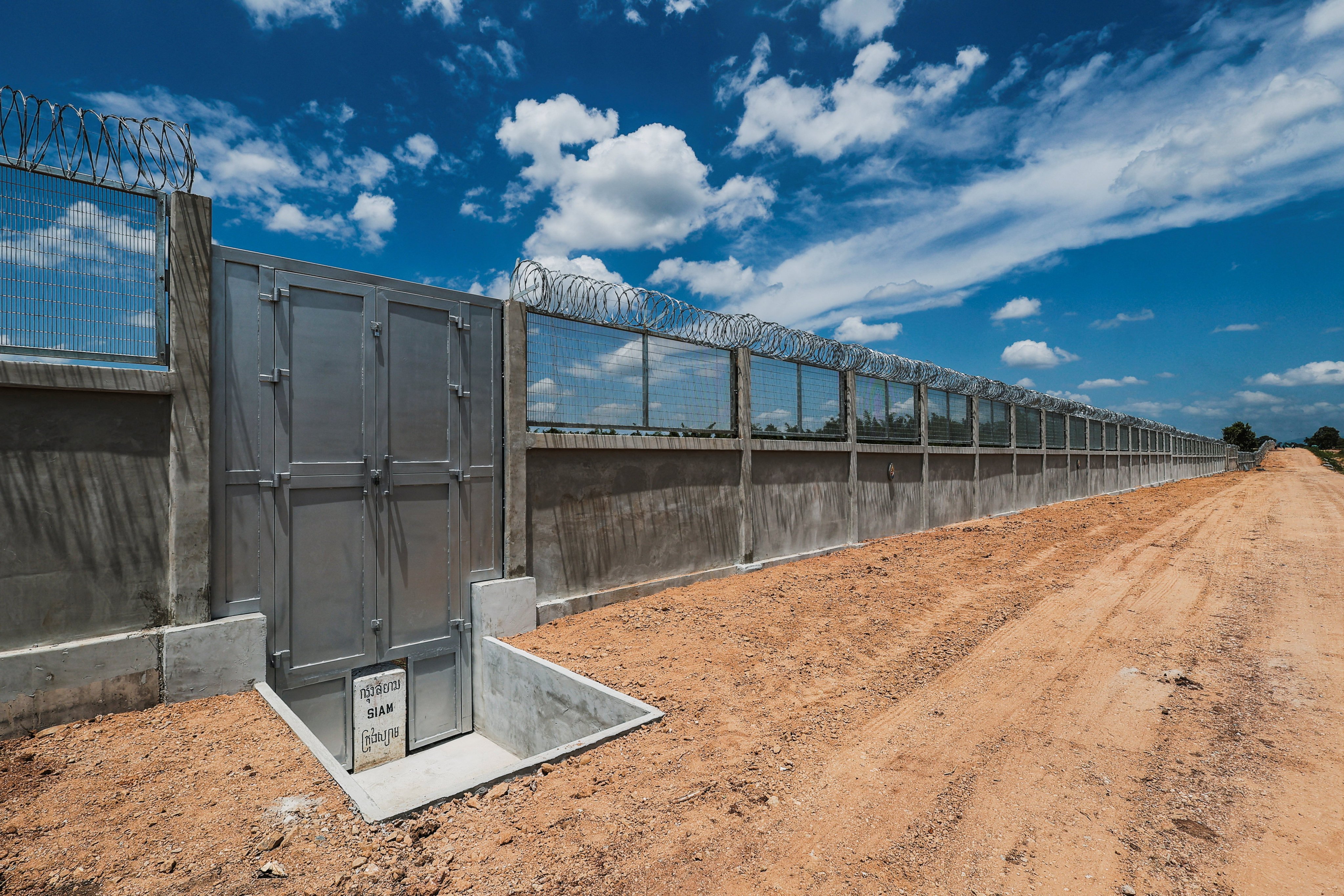
ceasefire, villagers in Chouk Chey found their access blocked by barbed
wire, stacked shipping containers, and warning signs that banned entry.
These measures were not put in place during shelling or air strikes.
They appeared after the fighting had stopped. In ceasefire situations,
timing is important.
Actions
taken after a truce cannot easily be explained as part of the chaos of
war. Instead, they raise questions about whether the ceasefire is truly
bringing stability or quietly changing the situation on the ground.
From
this point of view, the ceasefire described by Nikkei appears more
tactical than restorative. It has stopped the violence, but it has not
allowed civilians to return, move freely, or regain life as it was
before the conflict. Cambodian officials quoted in the article warn that
this situation shows how fragile the ceasefire is. A ceasefire that
prevents people from going back to their homes risks becoming only a
temporary pause, rather than a step toward long-term stability.

“The Cambodian scam industry generates billions of dollars annually and could not have operated on this scale without the protection or complicity of individuals far more powerful than a deputy director general of immigration,”


Yes, the Khmers in former Khmer provinces all over Thailand need to wake up and demand self-rule or independence for themselves. The Thais know it would be difficult and even impossible to prevent were these indigenous Khmers to rise up and form a separate state which could comprise up to one-third of what is now Thai territory including coastal and sea areas.
In the 1960s and 1970s Communist shells were active all over the North-East of Thailand with a large presence of ethnic Khmers living there. This is the least developed and most impoverished part of Thailand even today.
The Thais decided to quell the Communist rebels not by force but by giving them lands to own and feed themselves. However, these lands never belonged to the Thais but to the Khmers and their ancestors from before recorded history. The Thais have similarly largely succeeded in brainwashing the Khmers by teaching their children their distorted version of history and telling them they are distinct and separate from their brothers in Cambodia. They have also bought Khmer leaders off who were and are willing to be their accomplices in this indoctrination and treason to keep the Khmers under their control and in subservience to them by giving the Khmers this false identity that many among them call: "Siem Surin" or "Siam Buriram" etc.
The truth however will never change in terms of their roots, ancestry and DNA as Khmers. To even allow themselves to be considered "Siam Surin" is an ultimate affront to their Khmer ancestors who fought and sacrificed to preserve Khmer identity and territory from the Siamese/ Thais invaders and oppressors. They are also an affront to themselves and conscience by so doing and through their complicity in all the harm and violence that Thailand is committing against the people of Cambodia.
-Social media
^^^

Op-Ed: Thailand’s Lies Are No Longer Sustainable
On 5 January 2026, the Royal Thai Navy dismissed reports of property seizures as “fake news,” yet simultaneously stated that valuables found would be “secured and returned to lawful owners.” One cannot deny a seizure while explaining how seized items will be returned.
This contradiction alone exposes the dishonesty at the heart of Thailand’s claims. The situation is worsened by visual evidence. While Thai authorities insist they were merely “securing” Cambodian civilian property, videos filmed by Thai soldiers themselves show troops openly celebrating confiscated belongings.
This is not professional custody—it is the language and behavior of plunder. To describe such acts as protection is an insult to public intelligence. If Thailand claims civilian property was taken into custody, where are the inventories, custody records, and clear return procedures? None have been presented.
In any lawful operation, such documentation is mandatory. Its absence speaks volumes. The same applies to the demolition of civilian homes and farms.
Thailand has offered no explanation of what military necessity required immediate destruction rather than securing sites pending verification, as required under international humanitarian law. Finally, Thailand repeatedly asserts that all seized areas are indisputably Thai territory.
Where is the evidence? Where are the verified coordinates, legal instruments, and agreed maps to support this claim? Assertions without documentation are not sovereignty—they are propaganda.
This is not a series of mistakes. It is a pattern of deception. Peace, trust, and regional stability cannot be built on endless lies. The international community must now decide whether silence will continue to reward falsehood—or whether truth still matters.
Keo Chesda, Affiliate Researcher at the University of Cambodia

Photo shows Chen Zhi is the chairman of the Prince Holding. Photo from Prince Bank
By: Sao Phal Niseiy
January 7, 2026, 10:40 PM
PHNOM PENH— Cambodian authorities have arrested and extradited Chen Zhi, the founder and chairman of Prince Group who is under United States sanctions, at the request of Chinese authorities, in what the Interior Ministry described as an effort to combat transnational crime.
In an official statement issued on January 7, the ministry said Chen Zhi was arrested and extradited to China, along with two other Chinese nationals, Xu Ji Liang and Shao Ji Hui.
“This operation was carried out on 6 January 2026, following several months of joint investigative cooperation between the relevant authorities of the Kingdom of Cambodia and the People’s Republic of China,” the statement said.
The ministry added that Chen Zhi’s Cambodian citizenship had been revoked by royal decree in December 2025, in accordance with Cambodia’s Law on Nationality.
Chen Zhi’s arrest and extradition came a few months after the United States and the United Kingdom imposed sanctions on him and his conglomerate, Prince Group, in October.
Following the announcement of those sanctions, Cambodian authorities pledged to cooperate fully with the United States and the United Kingdom, guided by law and evidence, to address cyber scam operations.
Hun Sen has been installed in power to protect and facilitate external interests and to that end it is his duty and obligation to do whatever it takes to deny Khmer people and Cambodia genuine independence and sovereignty. In past and recent conflicts with Thailand (Cambodia has territorial dispute with Vietnam too involving land encroachments by that state, but Hun Sen can do little except yielding to Vietnam's extortions and demands as well as criminalising Khmers who even talk openly about the issue) if the world community has pulled its weight behind Cambodia - such as the ICJ's last ruling or clarification on the Preah Vihear territorial dispute - it is not because out of any support or sympathy towards the Hun Sen regime but, because Thailand's aggression against Cambodia and her people is wrong and a gross violation of international laws.
Throughout Hun Sen's ruling legacy it is abundantly clear that he would rather kill and imprison Khmer patriots and civil activists or critics of his regime and ceding Khmer territory to foreign powers, especially, Vietnam, than risking his own hold on power and political dynasty. Even in the caption in this video showing three important CPP figures one - to the far right in the picture - is of Vietnamese descend whose elder brother - Tea Banh - is a known Vietnamese protege/agent since his time in the Khmer Rouge regime and who still struggles to speak in Khmer or does so with a heavy Vietnamese accent.
-Social media.
^^^