
Shuttered borders have choked trade and sent migrant workers home, forcing Phnom Penh to seek new partners and markets
Published: 3:00pm, 17 Feb 2026Updated: 3:23pm, 17 Feb 2026
Cambodia is scrambling to shore up an economy battered by months of border conflict with Thailand, as shuttered crossings choke trade and hundreds of thousands of migrant workers return home to fewer jobs and lower pay.
Prime Minister Hun Manet is travelling to the United States and Europe this week seeking to diversify markets and secure new investment, part of a broader effort to reduce Cambodia’s reliance on Thailand after the fighting forced supply chains to be diverted and slashed remittance flows.
Months of border fighting in the second half of last year killed at least 149 people on both sides and brought the closure of land crossings that had handled about US$5.6 billion in trade.
Thailand’s Prime Minister Anutin Charnvirakul made the conflict and the border closure a feature of stump speeches during his election-winning campaign this month. While his win remains to be ratified by election authorities, the border remains closed and a touchstone issue for nationalists on both sides.
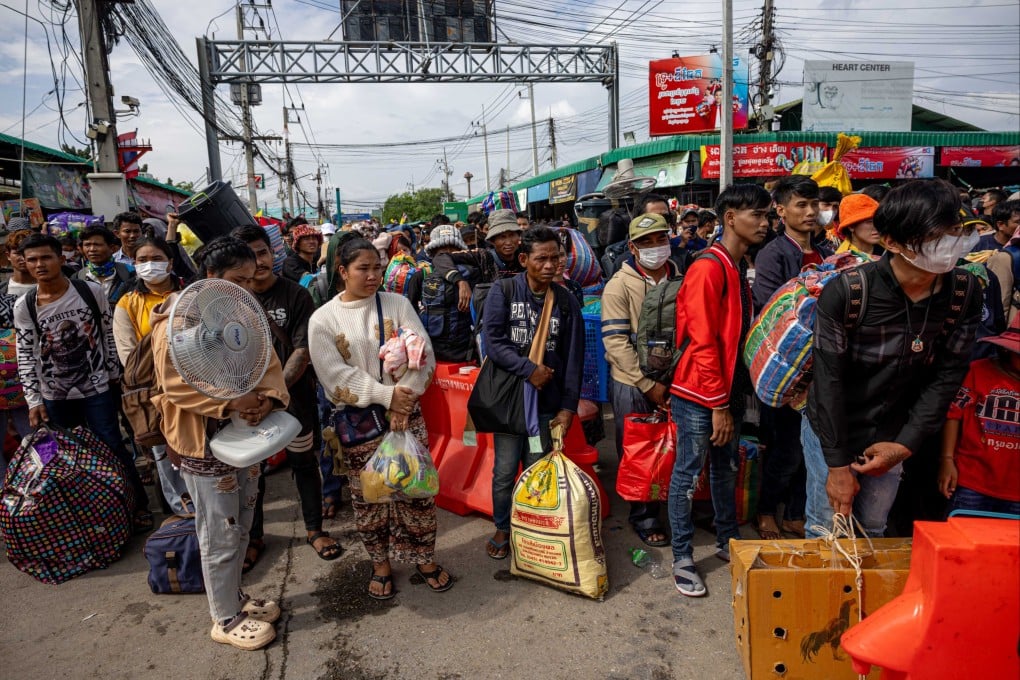
An estimated 900,000 of the 1.2 million Cambodians working in Thai construction sites, fields and factories have returned home so far, according to the International Labour Organization (ILO).
But there are only 400,000 jobs available, Cambodia’s Ministry of Labour has said.
“They went back in a rush to see what is available in their hometowns,” said Rebecca Napier-Moore, an ILO migrant advocacy rights officer. “Not everyone is finding work.”
Prime Minister Hun Manet is travelling to the United States and Europe this week seeking to diversify markets and secure new investment, part of a broader effort to reduce Cambodia’s reliance on Thailand after the fighting forced supply chains to be diverted and slashed remittance flows.
Months of border fighting in the second half of last year killed at least 149 people on both sides and brought the closure of land crossings that had handled about US$5.6 billion in trade.
Thailand’s Prime Minister Anutin Charnvirakul made the conflict and the border closure a feature of stump speeches during his election-winning campaign this month. While his win remains to be ratified by election authorities, the border remains closed and a touchstone issue for nationalists on both sides.
An estimated 900,000 of the 1.2 million Cambodians working in Thai construction sites, fields and factories have returned home so far, according to the International Labour Organization (ILO).
But there are only 400,000 jobs available, Cambodia’s Ministry of Labour has said.
“They went back in a rush to see what is available in their hometowns,” said Rebecca Napier-Moore, an ILO migrant advocacy rights officer. “Not everyone is finding work.”
Those who do are returning to salaries of around US$200–210 a month, roughly half of their earnings in Thailand, she added, money that had been remitted home to one of Southeast Asia’s poorest nations.
In December, a World Bank report warned that remittances – mostly from workers in Thailand – which make up 5.5 per cent of GDP, were projected “to drop by 60 per cent in the fourth quarter of 2025”.
Against that backdrop, Hun Manet landed in the US late Monday for the inaugural “Board of Peace” summit convened by US President Donald Trump, according to government mouthpiece Fresh News.
The son of former strongman Hun Sen has embarked on an intense round of diplomacy at home and abroad, seeking to build new alliances and shore up old ones after the border row with Thailand.
Cambodia’s central role in the global scam crisis has also incurred a diplomatic cost, with rare public admonishments from China and South Korea as they grow weary of abuses of their nationals and the targeting of their citizens from Cambodian crime hubs.
Hun Manet will later travel to Geneva and Brussels, as Cambodia looks to widen its economic options after the conflict with Thailand.
Inside Cambodia there are some signs of a bounceback for an economy initially dumped on the canvas by a border closure that forced suppliers to pay for expensive new routes in and out of the country. Tourist numbers have also tumbled due to the bad publicity caused by the conflict and the border closure.
“Supply chains have been reviewed,” said Sothea Rami Sambath, chair of EuroCham Cambodia’s FMCG (Fast Moving Consumer Goods) Committee.
“There was no circulation of goods, no supplies coming from Thailand, so most of the companies relying 100 per cent on Thailand – pre-packaged or produced there – were completely done.”
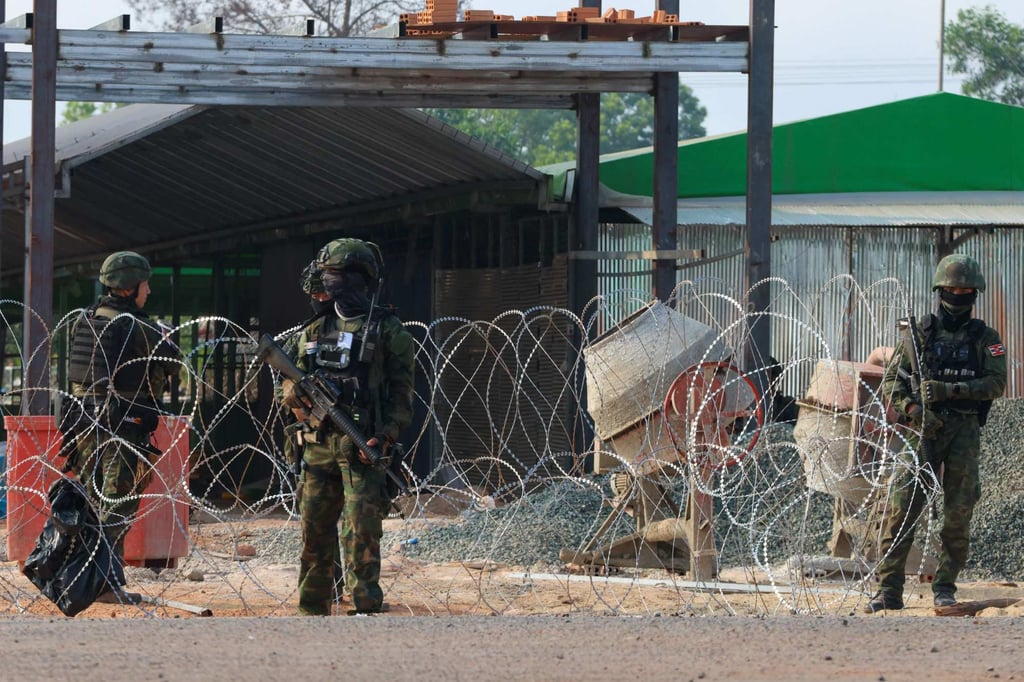
Thai soldiers stand beside barbed wire in Thma Da, Pursat province on February 7. Thai forces said they had taken control of disputed areas along the border during fighting with Cambodia in 2025. Photo: AFP
But as the border closure looks set to be long-term, those supply chains are being redistributed away from Thailand to Malaysia and Vietnam, he added.
Meanwhile, a deepening Cambodian consumer boycott of Thai goods and brands has forced some Thai-owned cafes and fast food chains to close and pushed global firms to source everything from cosmetics to canned milk from anywhere but Thailand, prodding domestic businesses to adapt.
“Now everyone is focusing on producing food products, seasoning, canned milk, instant noodles, whatever used to be produced in Thailand,” Sambath said. “It’s a good trend.”
Vietnamese firms are also discussing opening new factories in Cambodia, creating jobs and helping the economy diversify from its over-reliance on the garment sector, which has been hit by US tariffs, while the government has vowed to speed up long-planned infrastructure upgrades including arterial roads to Vietnam.
But as the border closure looks set to be long-term, those supply chains are being redistributed away from Thailand to Malaysia and Vietnam, he added.
Meanwhile, a deepening Cambodian consumer boycott of Thai goods and brands has forced some Thai-owned cafes and fast food chains to close and pushed global firms to source everything from cosmetics to canned milk from anywhere but Thailand, prodding domestic businesses to adapt.
“Now everyone is focusing on producing food products, seasoning, canned milk, instant noodles, whatever used to be produced in Thailand,” Sambath said. “It’s a good trend.”
Vietnamese firms are also discussing opening new factories in Cambodia, creating jobs and helping the economy diversify from its over-reliance on the garment sector, which has been hit by US tariffs, while the government has vowed to speed up long-planned infrastructure upgrades including arterial roads to Vietnam.
Keeping their heads down
While parts of the business sector are proving adaptive to the forced changes, the economic pain is deepening for low-skilled workers reliant on better wages in Thailand.
The challenges are particularly acute for “older [returnees] and women,” said Tun Sophorn, ILO national coordinator in Cambodia.
Women make up just under half of the returnees and while many have staffed the 230,000 vacancies in the garment sector, others have been thrust back into home roles that stretch their capacity to work, often as internal migrants.
“Women have a care responsibility too, it is unpaid care work now they are back,” he added.
Cambodia’s government has sought to show it can provide for its returned citizens, offering job fairs and US$100 vouchers for reskilling while opening new overseas migrant roles in Israel, South Korea and Japan.
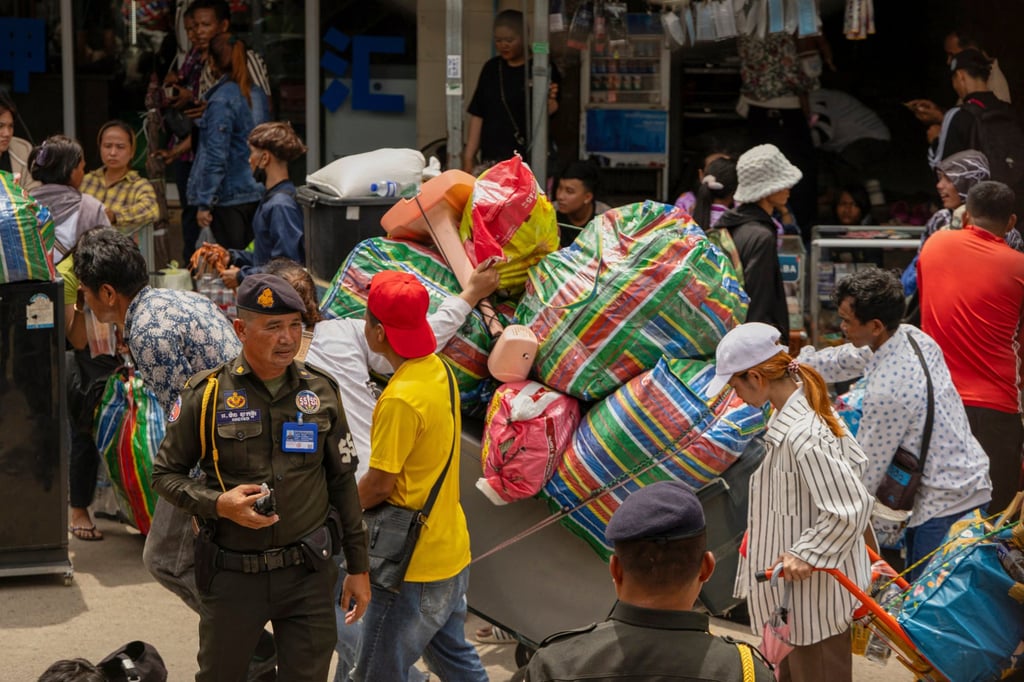
Military police patrol a main road in Kamrieng as migrant workers re-enter Cambodia through the Daung International Border Checkpoint on August 6, 2025. Photo: AP
In Thailand, the absence of Cambodian workers is being acutely felt, with labour shortages in sugar fields as harvest time gets under way near the border and across the construction sector.
“Cambodian labour is essential for heavy industries, where workers have strong skills and experience,” said Sompong Sakaew, director of the LPN Foundation, a leading migrant rights advocacy group.
“Lao workers generally do not take construction jobs – it’s not their area of expertise, and these labour forces are not interchangeable. Bangladeshi workers are also much more expensive.”
But surging nationalism and reports of abuse directed at Cambodian migrants – amplified by social media videos – are pushing more Cambodians to consider leaving, he said.
“For those who remain, companies have tried to boost morale and provide reassurance,” he said. “But many are keeping a low profile – they limit their movement, stay mostly in dormitories and focus solely on their work, keeping their heads down.”
Aidan Jones is a Senior Correspondent on SCMP's Asia desk. He previously worked at the Agence France-Presse.


No comments:
Post a Comment