
Cambodia Says Industrialized Nations Must Help Mitigate Climate Change
Like other countries, Cambodia is preparing its own plan to contribute to the fight against climate change.
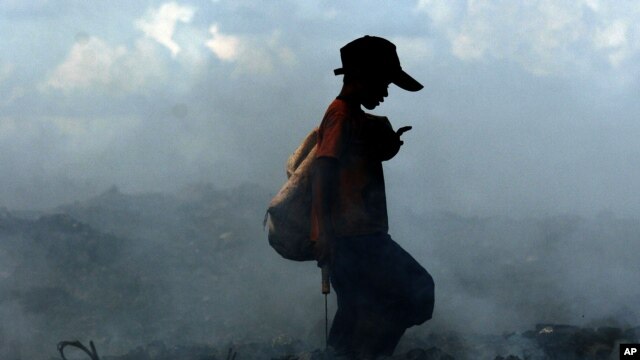 |
| Smoke from burning trash fires swirls around a Cambodian boy as he scavenges a dump on the outskirts of Phnom Penh, file photo. |
(((
School of Vice: Few developing or developed countries in the world have been so blessed with natural riches as had Cambodia in recent history. Tragically, fewer still have seen those riches decimated at the alarming rate that has been witnessed in the country since the early 1980s onward and into the present time.
Never mind global or even regional climate change patterns with adverse consequences; the country's gross and inexplicable disregard for its forestry and ancient ecosystem has been [in my view and observation] the single most salient contributing facilitator and driver of unprecedented 'environmental hemorrhage' - if there's such a thing, it would be found here!. Scientists have recently found evidence of drastic climate change in the same region that had coincided with the sudden demise of the Angkorian civilisation from around late 13th and 14th century onward; a demise attributed chiefly to that civilisation's reliance upon water and its irrigation management system. If this was indeed the case i.e. change brought about through natural agency, then the present on-going environmental catastrophe is indisputably entirely man-made. It's probably much too late now to reverse the impact of this environmental disaster, but it's never too late to halt all the activities behind the destruction.
From looking at most reports on the subject of deforestation and related phenomenon of large scale Economic Land Concessions [ELCs], one can't help but speculates that even a small fraction - say 20 - 30 per cent - of what profit has been made out of all this destruction would have sufficed to make even the notoriously rapacious and greedy ruling clans and elite of the country wealthy enough to last a few generations. Thus, the real lion's commercial share in all these activities [with the present foreign ownership of the Angkor Archaeological park as an example] can be said to be in the hands and grips of vested external interests other than Cambodians themselves; elite or otherwise. Meanwhile, the UN and western donors may have little choice but to pay lip service to these underlying systematic forces that fuel the misery of ordinary Cambodians and keep their nation precariously veering between brutal violent dictatorship and national oblivion while their representatives in the country [alongside entrenched bull-headed sections of foreign-owned newspapers] spend valuable time and resources reporting on "inflammatory rhetoric" coming from certain opposition figures, and stoking up imaginary "racial discrimination" against certain ethnic groups of their own?
)))
Phorn Bopha VOA Khmer
24 September 2015
PHNOM PENH—
As world leaders prepare for a major summit on climate change in Paris this December, Cambodian officials say industrialized nations should provide support to lesser developed countries, to offset their contributions to global warming.
Like other countries, Cambodia is preparing its own plan to contribute to the fight against climate change, under UN protocols called Intended Nationally Determined Contributions, or INDC.
That includes policies to preserve natural resources and biodiversity, Sao Sopheap, a spokesman for the Ministry of Environment, said.
Cambodia has seen a massive reduction to its forest cover over recent decades, losing a potential carbon sink that would mitigate climate change. Still, Cambodian officials say they are not a major greenhouse gas contributor and should receive support from those countries that are.
Still, Cambodia is willing to decrease its own emissions, Sao Sopheap said. “We are not a country that has as much greenhouse gas [emissions] as other countries with a lot of industry, so Cambodia is not compulsorily obliged to reduce greenhouse gases, but it is our political will, as Cambodia is a signatory of the UN,” he said.
Industrialized countries should take responsibility for climate change and help countries like Cambodia cope with it, he said. “Cambodia also demands technical support, as well as training in skills regarding reducing greenhouse gas,” he said. “We request that countries with heavy industry be accountable.”
In Cambodia, effects of climate change could mean shifts in weather patterns, creating drought in some areas and flooding in others. It will also affect the coast, as sea levels rise.
“We have many plans to be executed by state institutions, such as work at the coast,” Sao Sopheap said. “We are trying to improve their livelihoods, so they can live up to the costs of climate change. When we do this kind of work, we need technical and financial support.”
UN Environment Program Executive Director Achim Steiner said during a seminar in Sao Paulo recently that the world needs global cooperation to tackle climate change.
“Done right, the work toward these goals can lead the planet and its peoples toward a more prosperous, sustainable future,” he said, in a speech posted on UNEP’s website. “Our world is composed of systems too complex, too integrated for one body to tackle alone.”
NGO Forum Director Tek Vannarin said the government has taken about 60 percent of the input given by NGOs for its INDC. Cambodia must maintain its remaining forest cover, he said, not only to help battle climate change, but for the people who depend on it.
“We encourage relevant institutions to protect our last Cambodian forests, to promote Cambodia’s livelihoods, especially those under the poverty line, who can benefit from the mutual resources of forests in their area,” he said.
The government, meanwhile, can work to ensure that Cambodians live in green cities and clean environments, and to help cut down the use of individual vehicles, he said.
The NGO Forum will release its own report on climate change Oct. 25 and will request that the government include it in its report in Paris.


No comments:
Post a Comment