
COVID-19 may not topple Cambodia’s Hun Sen, but its shockwaves could spark the beginning of the end of his rule.
By David Hutt
April 02, 2020
Will the COVID-19 Crisis Spell the End of Cambodia’s Hun Sen?
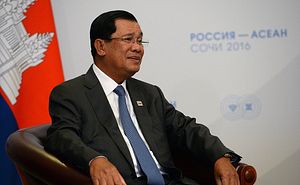
Credit: Wikimedia Commons
Cambodian Prime Minister Hun Sen is set to gain an unprecedented amount of power through the passing of a new “state of emergency” draft law, ostensibly designed to help the government tackle the coronavirus crisis. Rather ironically, at the same time, his political legacy as the person who brought peace and prosperity in Cambodia arguably risks being tainted beyond repair. He has never been so powerful yet so weak.
The health crisis because of the COVID-19 pandemic is only set to worsen in Cambodia in the coming months, though more deleterious may be the looming economic crisis. The World Bank now forecasts economic growth to slump to between 2.5 percent and 1 percent this year, but even that may be optimistic. It’s impossible to put succinctly just how many problems the economy faces – and by quite how much it could collapse.
The vital tourism and textile manufacturing sectors have been decimated because of the virus, and the rest of the economy is slowing grinding to a halt. But there numerous other non-coronavirus economic problems: a drought is ruining the rural economy; exports to Europe are imperiled by Cambodia’s partial removal from a European Union preferential trade scheme; the housing bubble has now burst and a debt crisis will only worsen; the escape valve of migration to Thailand is no longer an option.
Quite simply, the government doesn’t have the money to bail out the entire economy. It has put aside $2 billion to give tax holidays to businesses in the tourism and manufacturing sectors, and has promised to fund garment workers laid off because of the downturn. But the majority of small businesses and workers are unlikely to get any financial help from the state. Poverty rates will spike again, especially considering the difference for much of the population between “poverty” and “non-poverty” was less than $1 a day. Most small businesses will close. Foreign investors will take their money elsewhere.
The English vernacular has two popular sayings for when someone engages in the futile or irresponsible during a crisis. “Nero fiddles while Rome burns” is one, and “shuffling the deck chairs on the Titanic” is the other. Hun Sen has managed to commingle both metaphors since January, as he fumbled and misled the Cambodian public about the dangers of the COVID-19 crisis, which is now only worsening – and will probably do so for at least the next month or two.
In January, he blamed Cambodian students in Wuhan for being too wimpy for wanting to return home, and lambasted journalists for wearing face masks. “Cavalier” is too weak a word for his response. His entire response when the virus epicenter was in China was mendaciously designed to maintain close relationships with Beijing, not to protect the Cambodian people he is supposed to represent. Now the epicenter of the outbreak has shifted to the West, his government has finally gotten serious about the threat, but it’s much too late.
Fiddling for months, he last week engaged in a needless cabinet reshuffle that was planned but could have been postponed, given the crisis. Hun Sen claimed this was intended to replace older politicians. “They are old and they need to sleep more,” Hun Sen said of the replaced ministers, who were simply removed into new positions of senior ministers, whatever that entails. Granted, it’s always nice to see a generational shake-up, especially within this aging cabinet. But except for making Koeut Rith, Hun Sen’s go-to lawyer and adviser, the new justice minister, the reshuffle was of rather unimportant ministries; the Ministry of Posts and Telecommunications and Ministry of Religion and Cult, for instance. Nothing, indeed, was said about Minister of Health Mam Bunheng, who even the government-friendly Khmer Times has uncharacteristically hounded in recent weeks. Perhaps, though, Hun Sen is keeping Mam Bunheng so he can be blamed at a later date for the government’s disastrous handling of the crisis.
No one expects Hun Sen to fall from power because of this crisis. But it will tarnish his political legacy. For decades, he has told the Cambodian people that their society would descend back into the tyranny of genocide and civil war if he was ever removed from office. His corollary claim is that Cambodia’s peace and prosperity since the early 1990s (which are hard to overlook) are the direct result of his rule. While debatable, that is certainly an enticing promise for ordinary Cambodians. A social contract developed: the people stay out of politics, and Hun Sen makes sure the people get a little richer each year.
That has, generally, been true for the last two decades. But not anymore. The economy will now slip to one of its lowest growth rates in decades. In 2009, after the global financial crisis, it grew by just 0.1 percent but recovered quickly the following year. It would be a folly to simply expect the same “V-shaped” recovery this time around given how things look right now. Compared to 2009, the Cambodian economy is now far more complex, more dependent on Western markets, has less access to Western aid, and is intractably linked to the fortunes of China. More than that, Hun Sen still maintained some good will with Western governments in 2009. Now, he is a pariah.
By dissolving the main opposition party, the Cambodia National Rescue Party (CNRP), in 2017, and then rigging the 2018 election, Hun Sen’s goal was to create a stable enough political environment to ensure his ruling party’s authority over the coming years, so he could hand over power to one of his sons, most likely his eldest, the military chief Hun Manet. Succession is never easy, but a stable (or rigged) political system and a healthy economy make it more feasible. Now that’s up in the air.
Any succession plan is now all but out the window. Hun Sen knows that any attempt at a handover as the economy is in ruins, which it will be for several years, would be disastrous. Given that, we can likely expect Hun Sen to remain in office until at least the 2023 general election.
It’s unclear how this “state of emergency” draft law will be used, and it may even be formally dropped in a few months. But even so, its powers will likely remain in place for the foreseeable future given how it facilitates Hun Sen’s interests. If Hun Sen is to maintain his sole authority over politics, he will need to cajole an increasingly angry population, which will become even more disaffected as the economy tanks, unemployment rises, and more and more people are kicked off their land and from their homes. He will also need to cajole members of his ruling Cambodian People’s Party, who were happy to submit to Hun Sen’s personal domination when times were good, but will grow more fractious in leaner times.
Forget any major new rapprochement with the United States and the European Union; if Cambodia’s economy is to truly weather this storm, it will have to become even more dependent on Chinese largess given its already clear dependence on Beijing. And while this crisis will allow the opposition CNRP and its now-exiled or jailed leaders a brief window of opportunity to claw back support, as the economy slumps and anger mounts against the government, Hun Sen and his ruling party will cling even more onto autocratic authority.
Given all this, the opposition needs to play the game well in the coming months if it stands any chance of returning to Cambodian politics. Unfortunately, it doesn’t have a good track record at knowing when or how to strike. As a result, a far more likely scenario is that Hun Sen will now become an increasingly unpopular though more powerful ruler – a dynamic that can eventually spell the beginning of the end for strongmen like himself.
David Hutt
David Hutt is Southeast Asia columnist at The Diplomat based in Phnom Penh, Cambodia, where he has been based for more than two years.


2 comments:
Samdach Preah Corona Hun Sen,
You have always wanted to keep your power at the expense of Khmer people and Cambodia such as executing the K5 project, signing the bilateral treaties with your master Vietnam, mounting the 1997 coup d'Etat, allowing the illegal Vietnamese to fill Khmer land, putting the so called triangle area under Yuon's control, “playing game" with Corona virus, etc...
Hun Sen recognized that the CPP would lose the 2018 general election against the CNRP.
The cut of EBA was the result of the unconstitutional dissolution of the CNRP. Therefore, having or losing EBA is not relating to Cambodia's sovereignty as pretended by Hun Sen, but relating to Ah Chker Chkuot Hun Sen's persecution of the CNRP’s members as well as the dissolution of the CNRP and most importantly the suppression of the air from Khmer people – the democracy.
You can keep barking in the meantime about your regime’s resiliency, but you will be silent in about 2 years when the domino effects of No EBA takes over the situation.
Why do you want to stay in power so long ?
I think you want to stay in power until the Vietnamization of Cambodia is complete and your master Vietnam clearly knew that you were such a faithful slave who would do whatever it takes – killing Khmer people, ceding land to Vietnam, signing bilateral treaties favoring Vietnam - to stay in power.
It is about time that Khmer people show their courage and their spirit of nationalism to challenge this crazy animal Hun Sen …
The CIA should plan more viruses to Hun Sen's family.
Something that is powerful enough to wipe him and his family out from the face of the earth.
COVID-19 will not bring him down. Maybe COVID-20 or COVID-21 will. CIA is good in removing dictators. Why keep Hun Sen alive for too long? Cambodians have suffered enough because of him and his cronies.
Post a Comment