
Well, to be fair it's not all that hard to 'outmanoeuvre' your opponents when you have all the guns and tanks at your exclusive disposal and be prepared to hit them below the belt.
Hun Sen has in fact been outmanoeuvred by the democratic opposition a few times in his career and made critical miscalculations, but he also has always recovered himself politically from such mistakes by using the courts and the armed forces he controls to strangle and neutralise his rivals and opponents, denying them their deserved mandate in ruling politics and government.
Perhaps, only Hun Sen himself would truly believe he has the ability to 'outmanoeuvre' anyone in that crude, shameless sense. Of course, he does judging by his blood-stained legacy and lust for unaccountable power.
Cambodia’s prime minister has outmaneuvered political opponents and groomed his oldest son for power, but does he know when to walk away?
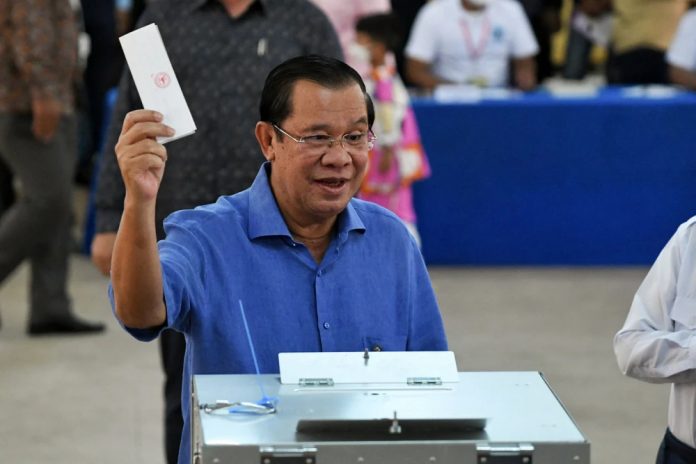
Cambodia’s ruling party once again waltzed to a lopsided victory in local elections this month, winning more than 99 percent of open commune chief seats amid allegations of irregularities. That wasn’t a surprise: Cambodian Prime Minister Hun Sen has ruled the country for nearly 40 years, and in 2017, a political crackdown on the opposition turned Cambodia into a de facto one-party state.
With elections meaningless, all eyes are on Hun Sen’s oldest son, Hun Manet. The 44-year-old has been groomed to succeed his father; he currently commands the Cambodian army. At its party congress last December, the ruling Cambodian People’s Party (CPP) formally anointed Hun Manet as its next candidate for prime minister when Hun Sen decides to step down. But the 69-year-old autocrat has approached his final political challenge—cementing his dynasty—with caution.
Hun Manet graduated from the United States Military Academy at West Point, and his Western education continued at New York University and the University of Bristol in the United Kingdom. He came to national attention in Cambodia when he took on a major role during border clashes with Thailand between 2008 and 2011. Since 2020, Hun Manet has served as the head of the CPP’s youth wing, widely seen as a training ground for the party’s next generation of leaders.
Cambodia’s national elections next year could ensure the smoothest transition for Hun Manet to the role of prime minister, as his father’s power has never been more secure. However, Hun Sen seems as reluctant as ever to let it go, making inconsistent statements about when his successor will take over. In 2017, Hun Sen said he would stay in power for at least 10 more years; in 2021, he gave himself another 10 years. He has previously indicated openness to Hun Manet taking over in 2028, an election year—while also floating the idea of 2029 or 2030.
Some observers suggest it could be even longer. “I have no doubt that Hun Sen will struggle to step down,” Lee Morgenbesser, a senior lecturer at Griffith University in Australia whose research focuses on authoritarian regimes, wrote in an email. “It is common for dictators who have been in power as long as he has to renege on their promise to leave (Mubarak in Egypt) or misjudge their level of support to stay on (Mugabe in Zimbabwe).”
Hun Sen seems aware that he’s at the peak of his power, as shown by his recent handling of a long-standing internal rival, Interior Minister Sar Kheng. When Hun Sen announced Hun Manet as his successor ahead of December’s party congress, endorsements rolled in from CPP leaders. Only Sar Kheng, who serves as CPP vice president and oversees the police, refused to back him. Hun Sen then mockingly dismissed Sar Kheng, saying it was “crazy, crazy, crazy” to consider that the interior minister could one day become prime minister.
The CPP also appointed two new vice presidents during the meetings: Cambodian Defense Minister Tea Banh and Deputy Prime Minister Men Sam An—both close allies of Hun Sen. This move served to shore up the prime minister’s support among military elites and to further dilute Sar Kheng’s influence. When it came time to vote, a defeated Sar Kheng joined the rest of the party in unanimously approving Hun Manet.
Hun Sen could likewise use the next decade to smooth Hun Manet’s road to power by phasing out the political elites who came of age during a period of conflict and turmoil in Cambodia, when it seemed anyone might come out on top. Some of Hun Sen’s peers may believe they could have been in his position if the chips had fallen differently. But the next generation of politicians has known nothing but Hun Sen’s leadership for most of their lives.
However, a lot could change for the Hun family in the coming years, particularly given looming economic challenges. In Cambodia, the economic fallout of the pandemic has been compounded by a debt crisis driven by an unscrupulous microfinance industry. Meanwhile, climate change, illegal fishing, and Chinese-financed dams threaten the Tonle Sap lake—the world’s largest inland fishery, which provides 60 percent of Cambodians’ protein intake—raising the specter of a food crisis.
Although the CPP has enjoyed five years with virtually no political challengers, discontent with Hun Sen’s rule remains. The Candlelight Party, which represents one faction of the fractured political opposition, had a disappointing performance in this month’s local elections, but it still won nearly 22 percent of the popular vote—even with its senior leaders in exile. It’s unclear if Hun Sen will turn on the Candlelight Party or allow it to build momentum, but both options carry risks. The prime minister is also getting old; if he suffers a medical emergency or rapid mental decline before Hun Manet has sufficient support, it could disrupt the succession plan.


1 comment:
Suddenly, the US is so concern about Cambodia because of the Chinese, but ignore the fact Vietnam and the evil Yuon did what the US accused the Chinese of doing. Secret deals and a puppet installed tyrant in Hun Sen. Remember, even the CNRP was winning and had a huge following when they spoke out against the evil Yuon. People in Cambodia even burned the evil Yuon's flag. Now they will be arrested and beaten if they did that. The CNRP is not even relevant and reduce to nothing. So much time was wasted and lives lost.
Post a Comment