
By Casey Barnett, President of AmCham Cambodia
In 2025, Thai accusations that Cambodian soldiers fired across the border are again being used to justify an ongoing Thai invasion of Cambodia. Similar claims formed the basis of Thailand’s 1941 invasion of Cambodia. Then, as now, Thailand’s military action was intended to annex Cambodian territory.
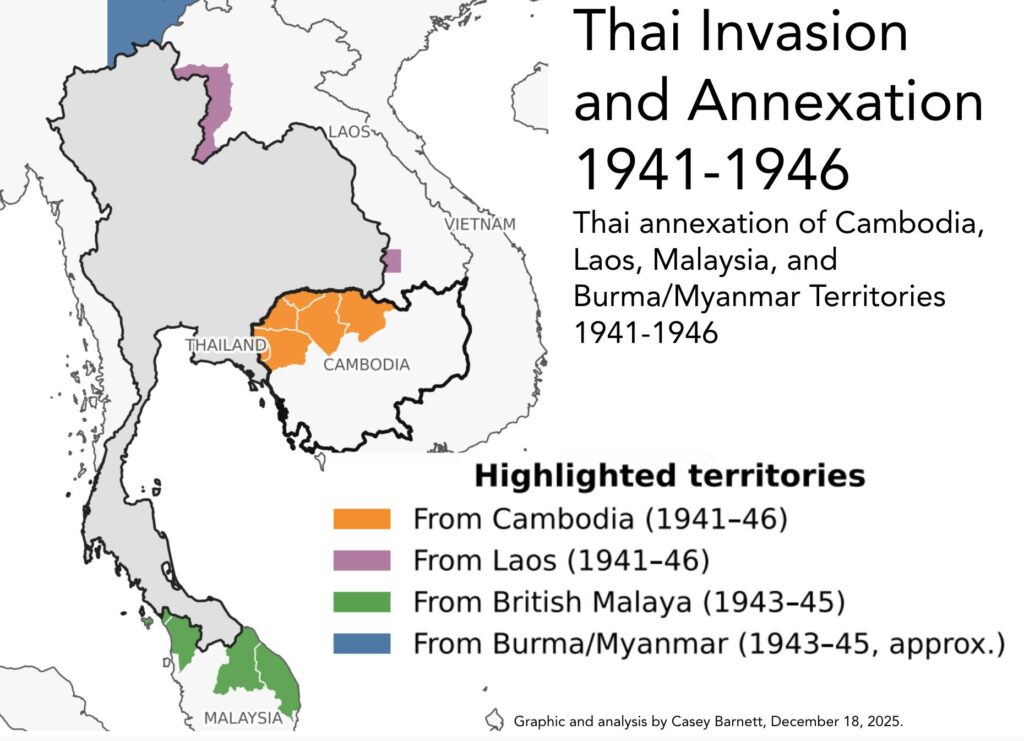
Despite full knowledge of Japan’s genocidal conduct in China, including the 1937 Nanjing Massacre in which approximately 200,000 civilians and prisoners of war were killed, Thailand entered into a treaty with Japan on June 12, 1940.² This agreement laid the groundwork for Japan’s subsequent occupation of French Indochina and British Malaya. After ratifying the treaty, Thailand invaded Cambodia and Laos in January 1941, claiming that French colonial forces in Cambodia had fired across the border into the Thai town of Aranyaprathet. In reality, Thailand had been preparing for invasion for months.³ Within weeks, Thailand forcibly annexed northern Cambodian provinces and western Lao territories.⁴
In December 1941, Thailand and Japan concluded a further agreement providing for mutual military support, with Japan explicitly backing Thailand’s territorial claims covering annexed areas of Cambodia, Laos, Malaya, and Burma.⁵ This agreement secured Thailand’s role as a logistics hub and staging ground for Japan’s conquest of British Malaya and Burma between 1941 and 1942.⁶

In July 1943, Japan rewarded Thailand for its cooperation by transferring to it six provinces of British Malaya and Burma.⁷ During this period, Thailand facilitated and materially benefited from Japan’s use of forced labor to construct the Burma Railway, linking Bangkok to Yangon.⁸ Among the enslaved laborers were 30,131 British and 686 American prisoners of war. Of these, 6,904 British and 131 Americans died as a result of brutal working conditions.⁹
Following the Allied victory in World War II, Thailand was compelled to relinquish all territories it had annexed in Cambodia, Laos, Malaya, and Burma. Britain initially sought punitive measures, including extended occupation of Thailand and potential control over the Thai Isthmus.¹⁰ The United States, however, opposed harsh postwar treatment, arguing that severe demands would destabilize Thailand and the wider region.¹¹ As a result, Thailand faced limited accountability for its wartime territorial aggression.
Now, in 2025, with little apparent collective memory of the consequences of its earlier irredentist ambitions, Thailand is once again invading Cambodia.


No comments:
Post a Comment