Sunday, 6 September 2026

Why Khmer people refer to Vietnam/Vietnamese "Yuon"

Cambodia: Legal Revisions Reinforce One-Party Rule


Amended Law Cuts Opposition Positions in Local Councils

3cb5cb49-500d-46c1-9dfe-e35e3b457b63

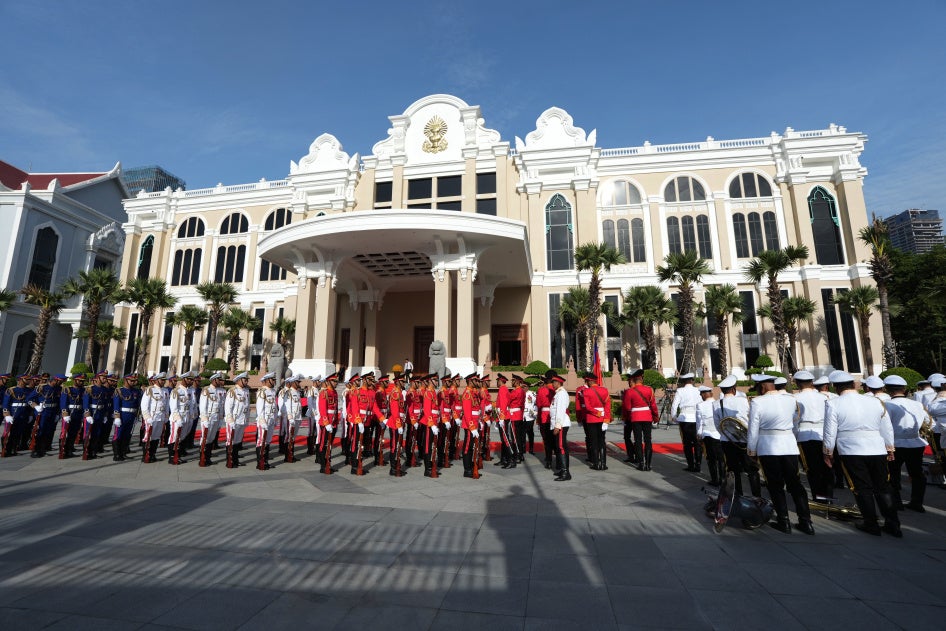
Cambodian Senate building, the Solidarity Palace, Phnom Penh, Cambodia, August 21, 2026.  © 2026 AP Photo/Heng Sinith 


(Bangkok, September 4, 2026) – The Cambodian government should withdraw proposed legal amendments that would drastically reduce opposition party representation in top positions on local councils, Human Rights Watch said today. 

On August 20, 2026, the Cambodian National Assembly, which is dominated by the Cambodian People’s Party (CPP), unanimously passed amendments to the Law on the Administration and Management of Commune/Sangkat. The changes to four articles in the law determine the apportionment of elected local council positions across Cambodia’s more than 1,600 communes. The Senate approved the amendments on September 4, which will be in effect for the next commune elections, slated for June 2027.

“The new amendments to Cambodia’s commune law, combined with the ruling party’s other repressive measures, appear aimed at eliminating opposition influence and cementing one-party rule at the local level,” said Bryony Lau, deputy Asia director at Human Rights Watch. “The Cambodian People’s Party is forever seeking to minimize if not eliminate the role of opposition politicians in the country’s rule.”

Tuesday, 25 August 2026

Indisputable, undeniable, unbiased Truth #8: The Angkor Temples were not built by a "super-civilization" 14,000 years ago and then claimed by the Khmers…


Ha ha ha... No, Angkor Wat and all these ancient temples were built by the Jews, Alexander The Great and yeah, the aliens!! 

Of course, the ancient Khmers 'wouldn't have the advance knowledge of astronomy, physics and mathematics' to be able to construct such grand sophisticated structures and on such a scale, surely? 

In deed, it is the living proof and undeniable evidence of this great genius of the Khmers and their glorious cultural heritage and roots that together form the essence and core of their distinct national identity that has given rise to jealousy, envy and fear in equal measure among neighbouring states and their rulers that in turn feed and fuel that sense of inferiority complex packaged and disguised as national xenophobia and ultra nationalism, manifesting through the callous violence against Cambodian civilians along with the deliberate destruction/ vandalising of their sacred temples such as Ta Krobey and Preah Vihear in the recent conflict between Thailand and Cambodia. 

-Social media  

Saturday, 22 August 2026

Cambodia: From Scam Empire to Security State


War with Thailand pushed Cambodia to enact a sweeping scam crackdown. Now the ruling elite is leveraging the same crackdown to consolidate its political control.

Cambodia: From Scam Empire to Security State

The remains of Me Teuk Bridge, previously the primary route into Thmor Da, in Cambodia’s Pursat province, as seen on Aug. 6, 2026. The bridge was destroyed by a Thai F-16 airstrike on Dec. 13, 2025.

Credit: Nathan Paul Southern
 

"A spokesperson for the Thai Ministry of Information did not respond to specific questions about civilian casualties at occupied scam compounds, but claimed all operations were “directed strictly at military targets.” The spokesperson claimed that Cambodian armed forces turned scam workers into human shields by using compounds as military bases and arms depots, launching attacks on Thailand from inside these sites, and that Thailand only discovered that industrial-scale online scams were operating after threats were neutralized and inspections conducted." 

"However, on multiple visits to O’Smach and Thmor Da since July 2025 we documented Thai surveillance drones closely monitoring areas with buildings densely populated by people who were clearly unable to leave. We could find no evidence that occupied compounds targeted by Thailand were being used by the Cambodian military, and no survivors interviewed said they witnessed this.

I never saw any [Cambodian] soldier,” said Paul. “Nobody was firing back. Just the attack from Thailand.”


It was two days after Christmas, just before 7 a.m., when Paul heard the first explosion. The 50-year-old Nigerian national had struggled to make a living as an English teacher in Vietnam and applied for a well-paid admin job in Cambodia, only to find he’d been sold to a criminal group running online scams. Beaten and tortured into compliance, he had been transported from site to site as bosses raced to evade a wave of raids on the country’s brutal scam compounds – by this point estimated to hold hundreds of thousands of people who, like Paul (we have changed his name for his safety), had been trafficked into forced criminal labor in the scam and illegal gambling industry.

By December, he was in Choam, a tiny jungle outpost where Khmer Rouge dictator Pol Pot is buried, confined to a scam compound complex centered around a casino that once served Thai gamblers hopping across the land border. That border had been closed since June, just before fighting broke out between Cambodia and Thailand. Now, after months of fragile peace, the conflict had erupted again.

Bosses told workers not to panic; Choam was not a target. Plus, Paul had never seen any sign of Cambodian soldiers or military vehicles from the windows of his guarded office-dormitory, and by the morning of December 27, the two sides had already negotiated a ceasefire. But hours before it came into effect, Thailand attacked.

“The next thing we start hearing, seeing drones. Blasting. Bombing upon bombing,” said Paul, his voice shaking. He says he survived by sheltering in a concrete drain, while scam bosses frantically hung Chinese flags from windows to show Thai surveillance the buildings were not Cambodian-controlled, but the main hotel-casino was hit again and again.

“A lot of people died there. And on the road, strings of bullets tearing the body of people’s cars,” he said. “If a bullet can tear a car [like that], what about a human being?”

Saturday, 8 August 2026

UN urges Cambodia to strengthen human rights protections


    Khmer Times
    
UN rights expert urges Cambodia to strengthen human rights protections amid  border conflict and scam crackdown

United Nations Special Rapporteur on the situation of human rights in Cambodia, Thomas Andrews

 
United Nations Special Rapporteur on the situation of human rights in Cambodia, Thomas Andrews, has called on the Cambodian government to strengthen its protection of fundamental freedoms, saying the Kingdom faces a series of human rights challenges linked to the border conflict with Thailand, transnational cyber scams and upcoming national elections.

Speaking at the conclusion of his first official mission to Cambodia at a press conference in Phnom Penh today, Andrews said recent crises also present an opportunity for the government to demonstrate its commitment to human rights through concrete action.

“My first mission to Cambodia has left me with deep concerns: for displaced people along the border with Thailand, for those who have been trafficked, and for those who are behind bars having exercised basic freedoms,” Andrews said in a statement released on July 31.

He said he had received information indicating that more than 100 people may currently be detained in Cambodia for exercising their rights to freedom of expression, peaceful assembly or association.

Hun Manet is refining Cambodia’s authoritarian model


The prime minister has made repression less visible and more sophisticated, strengthening the authoritarian system he inherited.  

By Mu Sochua
Former member of parliament, Cambodia, and vice president of the Cambodia National Rescue Party.
Published On 7 Aug 20267 Aug 2026

KUALA LUMPUR, MALAYSIA - OCTOBER 26: Cambodian Prime Minister Hun Manet attends the signing of a Cambodia-Thailand peace deal at Kuala Lumpur Convention Centre on October 26, 2025 in Kuala Lumpur, Malaysia. Trump is in Malaysia for the Association of Southeast Asian Nations (ASEAN) summit, and will next travel to Japan, en route to South Korea for the Asia-Pacific Economic Cooperation (APEC) forum. (Photo by Andrew Harnik/Getty Images) 
Cambodian Prime Minister Hun Manet attends the signing of a Cambodia-Thailand peace deal at Kuala Lumpur Convention Centre on October 26, 2025 in Kuala Lumpur, Malaysia [Andrew Harnik/Getty Images]


When Hun Sen handed Cambodia’s premiership to his eldest son, Hun Manet, in August 2023, many diplomats and regional observers saw the succession as an opportunity for change. The carefully stage-managed handover fuelled hopes that a new generation of leaders, headed by a prime minister educated at West Point, New York University and the University of Bristol, might reopen Cambodia’s political space after decades of authoritarian rule.

Writing at the time, I argued that this optimism was misplaced, not because the leadership was changing, but because the political system was not. Western policymakers were eager to believe that a dynastic transfer might create room to recalibrate relations with Phnom Penh. But they failed to recognise how deeply the Cambodian People’s Party’s survival depended on preserving the very institutions that had forced opposition figures such as me into exile. Hun Sen’s sweeping crackdowns on the opposition, independent media and civil society were not aberrations, but expressions of a governing model he had built and the ruling elite continued to sustain: one based on patronage, coercion and the elimination of political competition. As long as that model remained intact, there was little reason to expect a new leader to rule any differently.

Three years on, this assessment has been borne out. Hun Manet has not governed as the liberal reformer many hoped he would. Instead, he has preserved the foundations of his father’s rule while making its repressive machinery less visible and more institutionally sophisticated. Although violence has become less conspicuous, the regime increasingly relies on elite patronage, legal repression, digital surveillance and tighter control over communications. The result is a quieter but arguably more resilient authoritarian state.